AIG and the CDS Crisis
Why this note exists
The settlement-and-clearing note explains that Dodd-Frank mandated central clearing for standardized OTC (Over-The-Counter — traded bilaterally, not on an exchange) derivatives. But it doesn’t explain why — what specific failure made regulators decide bilateral trading was too dangerous. This note tells that story through its mechanics, not its headlines: what AIGFP actually sold, why no one demanded collateral, how mark-to-market losses — not actual defaults — triggered the liquidity crisis, and what central clearing would have changed.
Prerequisites
- settlement-and-clearing — CCP clearing, novation, margin, default waterfall
- market-fundamentals — buy-side/sell-side, asset classes
- Familiarity with what a CDS is (insurance-like contract that pays out if a reference entity defaults). A dedicated CDS note is planned under credit-risk/.
Sources
FCIC (Financial Crisis Inquiry Commission), The Financial Crisis Inquiry Report (2011). GAO (Government Accountability Office)-09-490T, Systemic Risk: CDS (2009). GAO-13-180, Status of Government Assistance Provided to AIG (2013). McDonald & Paulson, “AIG in Hindsight,” NBER (National Bureau of Economic Research) WP 21108 (2015). Dodd-Frank Act, Pub. L. 111-203, Title VII. EMIR, EU Regulation No 648/2012. ISDA (International Swaps and Derivatives Association) SwapsInfo (2024-25).
What AIGFP Actually Did
AIG Financial Products (AIGFP), based in London and Wilton, Connecticut and run by Joseph Cassano, sold credit default swap (CDS) protection on super-senior tranches of multi-sector collateralized debt obligations (CDOs). These CDOs were primarily backed by residential mortgage-backed securities (RMBS), including substantial subprime exposure.
Why “Super-Senior” Matters
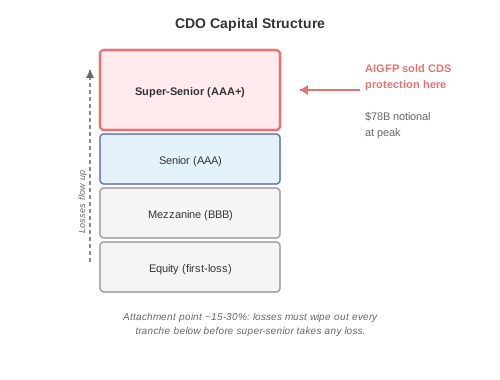 CDO capital structure. AIGFP’s CDS protected the super-senior tranche —
above even the AAA-rated senior tranche. Losses must wipe out every
subordinate tranche before the super-senior takes any hit.
CDO capital structure. AIGFP’s CDS protected the super-senior tranche —
above even the AAA-rated senior tranche. Losses must wipe out every
subordinate tranche before the super-senior takes any hit.
In a CDO’s capital structure (see the structured products roadmap for the full tranching mechanics), losses are absorbed from the bottom up:
- Equity tranche (first-loss, unrated) — absorbs the first ~3-7% of losses.
- Mezzanine (BBB-rated) — absorbs losses after equity is wiped out.
- Senior (AAA-rated) — absorbs losses after mezzanine is gone.
- Super-senior (above AAA) — only takes losses after every other tranche, including the AAA tranche, has been wiped out. Typical attachment point: 15-30% of the pool.
AIGFP’s internal models — using a variant of the Binomial Expansion Technique (BET, a model originally developed by Moody’s for estimating default distributions in CDO pools) — calculated the probability of loss on the super-senior tranche as effectively zero:
“AIG’s models predicted that there was a 99.85% chance of never having to make a payment on the super-senior CDS contracts.” — FCIC Report, p. 265
The Numbers
| Metric | Value | Source |
|---|---|---|
| CDS notional on multi-sector CDOs (peak, YE 2007) | ~$78B | FCIC, p. 265 |
| Total AIGFP CDS/derivatives notional (all types) | ~$2.7T | FCIC, p. 344 |
| CDS on corporate debt (separate book) | ~$379B | FCIC |
| Regulatory capital CDS (for European banks) | ~$379B | GAO-09-490T |
The $78 billion in multi-sector CDO super-senior CDS is the number that mattered. The corporate CDS book performed fine — it was the structured credit book that destroyed the firm.
Key Counterparties
When Maiden Lane III (an SPV — Special Purpose Vehicle — created by the Fed to unwind AIGFP’s positions) was established, the Fed disclosed the counterparties:
| Counterparty | CDS Notional (~) |
|---|---|
| Goldman Sachs | $22.1B |
| Societe Generale | $16.5B |
| Deutsche Bank | $8.6B |
| Merrill Lynch | $6.2B |
| Calyon (Credit Agricole) | $4.3B |
| UBS | $3.8B |
| Barclays | $1.5B |
(Sources: FCIC Report pp. 376-377; GAO-09-490T pp. 13-15; Fed ML III disclosures)
A crucial point: many counterparties were European banks using the CDS to reduce regulatory capital requirements under Basel II (the international banking regulation framework that set minimum capital requirements based on risk-weighted assets). By buying super-senior protection from AAA-rated AIG, they could substitute AIG’s 20% risk weight for the asset’s 100% risk weight, freeing up capital. This was as much a regulatory arbitrage story as a risk transfer story.
The AAA Shield: Why There Was No Margin
AIG’s parent company held a AAA credit rating from all three agencies — a distinction shared by only a handful of corporations globally. The CDS contracts (ISDA master agreements — the standard contract template for OTC derivatives — with credit support annexes, or CSAs — addenda specifying when and how much collateral each party must post) included collateral posting provisions, but with terms extremely favorable to AIG:
- No initial margin was required from AIG (the protection seller).
- Variation margin (mark-to-market collateral) was only triggered if:
- AIG’s credit rating fell below a specified threshold (typically AA- or A+), or
- The mark-to-market losses exceeded certain thresholds.
Because AIG was AAA, counterparties considered the credit risk negligible. This was bilateral OTC — no clearinghouse, no daily margin, no independent price verification. Each CSA was negotiated deal-by-deal.
“Because of AIG’s AAA rating, counterparties, such as Goldman Sachs, did not require AIG to post collateral against its CDS positions until the market value of the underlying CDOs fell or AIG’s own ratings were downgraded.” — FCIC Report, p. 268
Compare this to what would happen under central clearing: a CCP would have demanded initial margin from Day 1 and daily variation margin regardless of AIG’s credit rating.
The Collateral Call Timeline
As subprime losses mounted, the mark-to-market on AIGFP’s CDS portfolio deteriorated — even though few actual credit events (= bond defaults triggering CDS payouts) had occurred yet:
| Date | Event | Cumulative Collateral Posted |
|---|---|---|
| Mid-2007 | Goldman Sachs makes first collateral calls. AIGFP disputes the valuations. | Disputed |
| Aug 2007 | Subprime crisis accelerates. More counterparties call. | ~$1.8B |
| Nov 2007 | PricewaterhouseCoopers identifies “material weakness” in AIGFP’s CDS valuation controls. | ~$2.5B |
| Dec 31, 2007 | Year-end. | $2.88B |
| Q1 2008 | Bear Stearns collapses (March). Housing deterioration continues. | ~$9.7B |
| May 2008 | Moody’s downgrades AIG (Aa2 to Aa3). More collateral triggers activate. | ~$13.2B |
| Jun 2008 | AIG reports largest quarterly loss in its history. | ~$15B |
| Sep 12, 2008 | Total calls reach $23.4B. AIG has posted $18.9B. | $18.9B |
| Sep 15, 2008 | Lehman fails. All three agencies downgrade AIG below AA-. This triggers collateral acceleration clauses across virtually all CSAs simultaneously. | $19.6B (cash exhausted) |
| Sep 16, 2008 | Fed announces $85B credit facility. | — |
(Sources: GAO-09-490T pp. 10-14; FCIC Report pp. 268-272, 344-346; NBER WP 21108)
The Goldman dispute is well-documented: Goldman’s marks were consistently more aggressive (lower) than AIGFP’s internal marks. Cassano’s team pushed back, arguing Goldman was using “distressed” valuations. The FCIC concluded Goldman was closer to correct.
The Cascade Mechanism
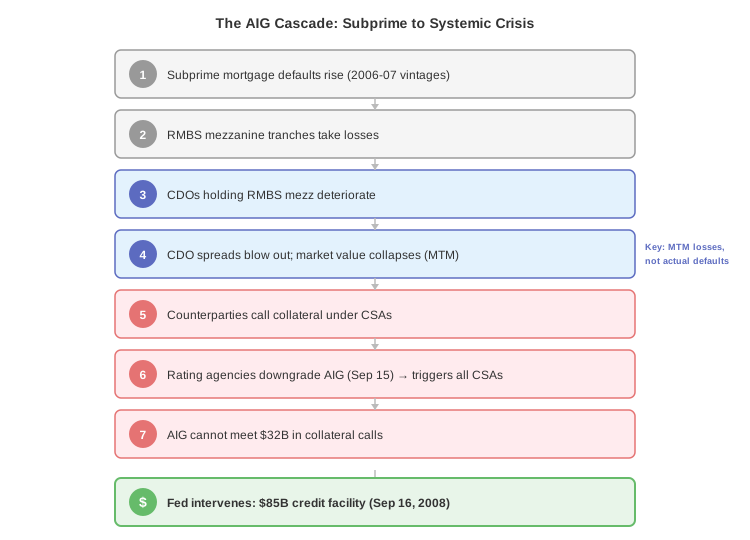 The seven-step cascade from subprime defaults to AIG’s liquidity crisis.
Grey steps are the housing market; blue steps are the structured credit
chain; red steps are AIG’s liquidity crisis.
The seven-step cascade from subprime defaults to AIG’s liquidity crisis.
Grey steps are the housing market; blue steps are the structured credit
chain; red steps are AIG’s liquidity crisis.
Step 1-2: Subprime Defaults and RMBS Losses
Starting in 2006, delinquency rates on subprime mortgages from the 2005-2007 vintages rose sharply. Underwriting standards had collapsed: NINJA loans (No Income, No Job or Assets), stated-income loans, and 2/28 ARMs (adjustable-rate mortgages with a low teaser rate for 2 years that reset to a much higher rate for the remaining 28 years). As defaults rose, losses ate through the equity and mezzanine tranches of the RMBS pools. Eventually, even senior RMBS tranches were impaired.
Step 3-4: CDOs Take Cascading Losses
The CDOs that AIGFP had written protection on held pools of RMBS tranches — often mezzanine tranches of RMBS. This is the CDO-squared problem: a CDO holding lower-rated slices of already-troubled RMBS.
As the underlying RMBS deteriorated, CDO tranche losses cascaded upward. But here is the critical mechanical point — AIGFP’s problem at this stage was primarily a collapse in mark-to-market (MTM) valuations, not actual credit event losses:
- Actual credit event losses (physical defaults triggering CDS payouts) were still relatively small by September 2008 — a few billion. The subordination was providing some protection.
- Mark-to-market losses were enormous because:
- Spreads on structured credit blew out.
- Liquidity evaporated (no one wanted to buy CDOs).
- Market participants were repricing correlation assumptions.
- ABX indices (tradable indices tracking subprime RMBS prices) were in freefall.
The CSAs required AIG to post collateral based on MTM, not just on actual defaults. So even though the super-senior tranches hadn’t defaulted, their market value had plummeted, triggering collateral calls.
MTM vs actual default — the key distinction
This is analogous to a futures position where daily mark-to-market margin calls can kill you with a temporary liquidity squeeze, even if you’d ultimately be correct about the direction. The mechanism of death was liquidity, not insolvency — at least initially. The FCIC Report debates whether AIG was ultimately insolvent; the answer is: eventually yes, because actual losses were also enormous. But the trigger was a liquidity crisis.
Step 5-7: Collateral Calls and the Downgrade Spiral
As MTM losses grew, counterparties called for collateral. AIG paid — but the calls kept growing. Then on September 15, 2008, Lehman Brothers failed. All three rating agencies downgraded AIG below AA- on the same day. This triggered collateral acceleration clauses across virtually all CSAs simultaneously — a cliff event. Calls spiked to ~$32B; AIG had posted $19.6B and had no cash left.
AIG was simultaneously being squeezed from a second direction: its securities lending program had invested cash collateral from securities borrowers into RMBS and other long-dated structured products. When borrowers returned securities and wanted their cash back, AIG couldn’t liquidate the RMBS fast enough.
“AIG had two separate but related liquidity crises: the CDS collateral calls on AIGFP and the cash demands from the securities lending program.” — FCIC Report, p. 344
The Bailout
The $182 billion figure represents peak committed exposure across multiple facilities — not a single check.
Federal Reserve Facilities (~$112.5B committed)
| Vehicle | Structure | Amount | Purpose |
|---|---|---|---|
| Revolving Credit Facility | Secured loan | $85B initially, revised to $60B | General liquidity |
| Maiden Lane II | SPV (Fed lent, AIG contributed $1B equity) | $22.5B (Fed) | Purchased RMBS from AIG’s securities lending portfolio at ~50c on the dollar |
| Maiden Lane III | SPV | $24.3B (Fed) + $5B (AIG) | Purchased the CDOs underlying AIGFP’s CDS at par, allowing CDS to be terminated |
Maiden Lane III caused the most political controversy. The Fed bought the CDOs from AIG’s counterparties at par (100 cents on the dollar), tore up the CDS contracts, and put the CDOs into a run-off vehicle. Goldman, Societe Generale, Deutsche Bank, and others were made completely whole — no haircut.
Treasury/TARP (~$69.8B)
TARP (Troubled Asset Relief Program) was the $700B Treasury program authorized by the Emergency Economic Stabilization Act of 2008.
| Instrument | Amount |
|---|---|
| Series C Preferred Stock (TARP injection) | $40B |
| Series E & F Preferred Stock (exchanged for equity) | $29.8B |
| Government equity stake | 79.9% |
Total Recovery
By December 2012, the government had exited all AIG positions:
| Entity | Invested | Recovered | Profit |
|---|---|---|---|
| Federal Reserve | $112.5B | $130.2B | +$17.7B |
| Treasury (TARP) | $69.8B | $74.8B | +$5.0B |
| Total | $182.3B | $205.0B | +$22.7B |
(Source: U.S. Treasury AIG status page; GAO-13-180)
Maiden Lane II earned ~$2.8B profit; Maiden Lane III earned ~$6.6B profit. The toxic CDOs, held to maturity through the crisis trough, actually recovered substantially as housing stabilized.
This is the ultimate irony: the “toxic assets” were worth something. AIG’s problem was that it couldn’t survive the interim liquidity squeeze to find out.
Dodd-Frank Title VII: The Regulatory Response
The Wall Street Reform and Consumer Protection Act (Pub. L. 111-203, July 21, 2010), Title VII — “Wall Street Transparency and Accountability” — directly addressed the OTC derivatives market:
| Provision | What It Did | AIG Connection |
|---|---|---|
| SS 723: Clearing requirement | Standardized swaps must clear through a DCO (Derivatives Clearing Organization) | A CCP would have imposed daily margin on AIGFP |
| SS 724: Swap execution facilities | Cleared swaps traded on registered SEFs (Swap Execution Facilities) or DCMs (Designated Contract Markets) | Pre-trade transparency; no more purely bilateral opaque deals |
| SS 731: Registration | Major swap participants must register with CFTC (Commodity Futures Trading Commission) | AIGFP would have been classified as a major swap participant |
| SS 725: CCP risk management | CCPs must have risk management frameworks, default funds, margin models | Addresses “who watches the watchers” |
| SS 729: Reporting | All swaps reported to SDRs (Swap Data Repositories) | Regulators would have seen AIG’s concentrated $78B exposure building up |
EMIR (EU Regulation No 648/2012) mirrors Title VII for Europe: mandatory clearing, trade repository reporting, bilateral margin requirements for non-cleared derivatives. Phased in 2016-2019.
What Central Clearing Would Have Changed
The three critical differences between AIGFP’s bilateral world and a cleared world (see novation for the structural diagram):
- Initial margin from Day 1. AIG would have posted significant IM upfront — conservatively 5-15% of $78B notional, or $4-12B locked up on day one. This alone might have limited the position to a fraction of its actual size.
- Daily variation margin. No waiting for rating downgrades. As MTM deteriorated, AIG would have faced calls daily starting in mid-2007, creating an early warning system rather than a cliff event on September 15.
- Position transparency. The CCP and regulators would have seen AIGFP’s concentrated $78B exposure building over time.
What Fraction of CDS Is Centrally Cleared Today?
| Segment | % Centrally Cleared | Source |
|---|---|---|
| CDS Index (CDX, iTraxx) | ~80-85% | ISDA SwapsInfo, Q1 2024-25 |
| Single-name CDS | ~45-50% | ISDA, May 2024 |
| Bespoke/structured credit CDS | ~0% | Still bilateral |
(Sources: ISDA SwapsInfo; ISDA “A Cornerstone of CDS Clearing,” May 2024; CFTC Weekly Swaps Report)
The critical gap: bespoke structured credit CDS — exactly the type AIGFP wrote — is still not centrally cleared. It’s too customized for standardized clearing. The mandate primarily captured the liquid, standardized index and single-name market. Whether this solves the actual problem or just the adjacent standardized problem is an open question.
The Counterargument: Does Central Clearing Just Concentrate Risk?
The “CCP as Super-Systemic” Argument
Critics (including Darrell Duffie at Stanford and Craig Pirrong at Houston) argue:
- CCPs are now “too big to fail.” If a CCP like ICE (Intercontinental Exchange) Clear Credit or LCH (London Clearing House) fails, the systemic consequences are arguably worse than AIG’s failure, because the CCP is counterparty to everyone.
- Risk is transformed, not eliminated. Bilateral counterparty credit risk becomes CCP default fund mutualization risk + operational risk + liquidity risk at the CCP.
- Procyclical margin calls. CCPs raising margin requirements during a crisis (as they must mechanically) can accelerate liquidation spirals — the very problem that killed AIG, now imposed systematically on all participants simultaneously.
The Counterfactual: AIGFP’s CDS Through a CCP
What would have been different:
- AIGFP posts $4-12B initial margin on Day 1 — making the position far more expensive and likely limiting its size.
- Daily variation margin forces AIG to post collateral continuously from mid-2007. The slow bleed would have been visible.
- The CCP conducts stress tests and potentially imposes position limits on a concentrated exposure.
But would the CCP have survived? At the moment of the September 15 downgrade, AIGFP’s collateral shortfall was ~$12.4B ($32B in calls minus $19.6B posted). If this hit a CCP, it would cascade through the default waterfall:
- AIG’s initial margin (~$8B)
- AIG’s default fund contribution (~$1-2B)
- CCP’s own equity (“skin in the game”)
- Mutualized default fund from all other clearing members
- Variation margin gains haircutting (VMGH — the CCP pays winning positions less than owed)
- Resolution — the CCP enters a bankruptcy-like process
With daily margining, the shortfall at any single point would likely have been much smaller — perhaps $1-3B rather than $12B, because the pain would have been spread over months of daily calls. The CCP would likely have survived.
The real mechanism is that central clearing converts catastrophic surprise into slow managed wind-down. AIG would have been forced to close out or reduce positions much earlier as it struggled to meet daily margin. Central clearing doesn’t prevent losses — it prevents the cliff.
The Unsettled Debate
CCP resolution regimes (codified in FSB — Financial Stability Board — guidance, the EU CCP Recovery & Resolution Regulation of 2020) remain largely untested. The scenario of a major clearing member default causing CCP failure is the financial system’s current “nightmare scenario,” and regulators are keenly aware of it.
For rigorous treatment: Duffie, How Big Banks Fail and What to Do About It (2010); Pirrong, The Economics of Central Clearing: Theory and Practice (2011); FSB, Guidance on Central Counterparty Resolution and Resolution Planning (2017).
Questions to sit with:
-
AIGFP’s internal models gave a 99.85% probability of never paying out. The models weren’t wrong about individual tranches — the super-senior attachment point was genuinely high. The failure was in correlation: when subprime collapsed, losses didn’t stop at the mezzanine; they cascaded through every tranche simultaneously because the underlying mortgages were all exposed to the same housing market. The Gaussian copula model assumed a single static correlation parameter. If you were building a risk model for super-senior CDO tranches today, what would you change about the correlation assumptions, and how would you stress-test for the scenario that actually occurred?
-
The MTM-vs-default distinction is the mechanical heart of the crisis. AIG died from a liquidity squeeze on mark-to-market collateral calls, not from actual credit event payouts. But Maiden Lane III later profited by holding the CDOs to maturity. Does this mean AIG was “right” about the super-senior risk and was killed only by a temporary liquidity crunch? Or does the inability to survive interim MTM calls reveal that the position itself was reckless regardless of ultimate recovery?
-
The note shows that bespoke structured credit CDS — exactly the type AIGFP wrote — is still not centrally cleared today. If the same product with the same characteristics isn’t subject to the mandate, how effective was Dodd-Frank Title VII at preventing a repeat? Is the answer that the standardized market (index, single-name CDS) is now safe, and the bespoke market simply stayed too small to be systemic? Or could a new AIG accumulate concentrated bilateral exposure in bespoke CDO CDS today?
See also
- settlement-and-clearing — CCP clearing, novation, margin, and the default waterfall that would have applied
- Structured Products — CDO mechanics, tranching, the Gaussian copula model
- Binomial Expansion Technique — the model that concluded super-senior losses were negligible
- Regulatory Capital Arbitrage — how European banks used AIGFP’s CDS to reduce capital requirements under Basel II
- confidence-levels-in-risk — VaR confidence levels and the math behind CCP margin calibration