Tangent Vectors and the Unit Normal on Graph Surfaces
A surface in is a two-dimensional shape embedded in three-dimensional space. To do calculus on surfaces --- compute areas, integrate functions over them, measure flux through them --- we need to understand the surface’s local geometry at each point: which directions lie “along” the surface, and which direction points “away” from it.
This note answers those questions for graph surfaces of the form . The key ideas:
- Tangent vectors at a point on the surface are found by slicing the surface with coordinate planes and differentiating the resulting curves.
- The tangent plane at is spanned by two such tangent vectors.
- The normal vector is perpendicular to the tangent plane, found via the cross product.
Graph surfaces
A graph surface is a surface defined by
where is a differentiable function. The variables and are independent (they can take any values in the domain of ), while is dependent (determined by and through ).
Examples: is an inverted paraboloid (a dome); is a saddle surface; is the upper hemisphere.
Scope
Not every surface is a graph. A full sphere fails the vertical line test --- a single pair may correspond to two -values. The techniques in this note apply only to graph surfaces. General surfaces require parametric descriptions , which is a later topic.
Tangent vectors from coordinate slices
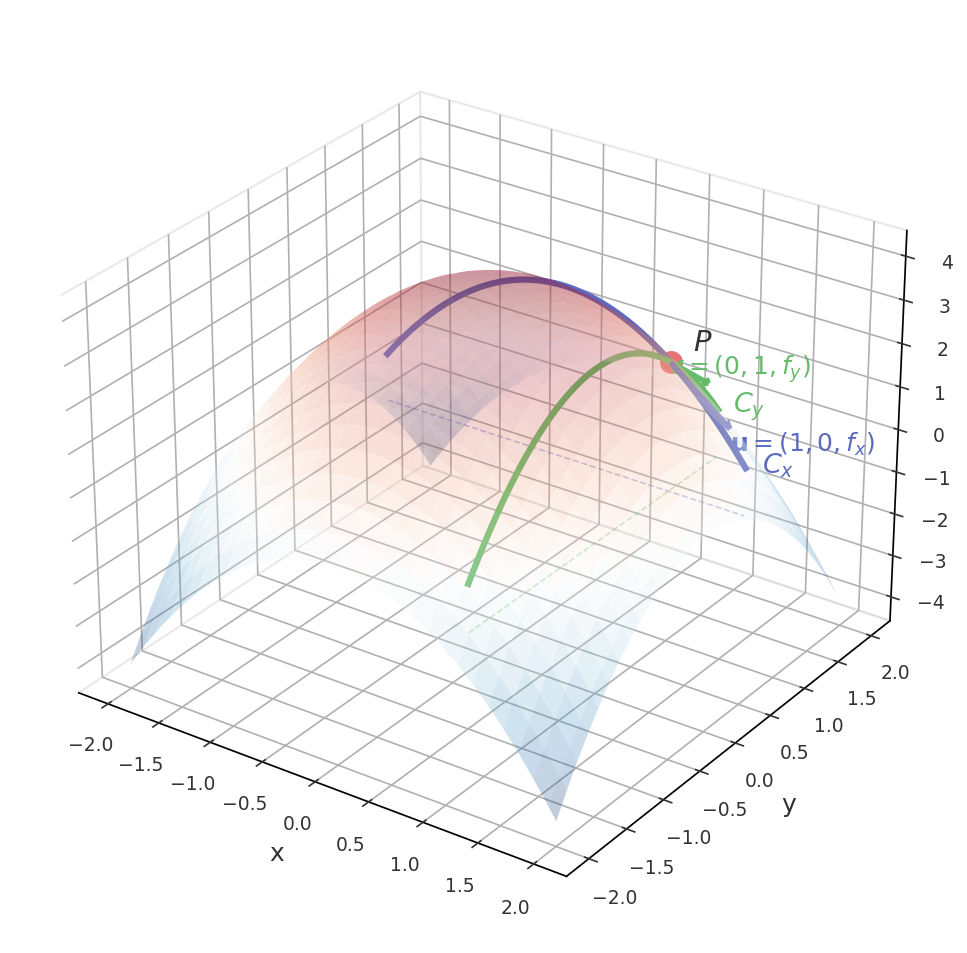
The diagram shows the surface with two coordinate slice curves at : fixing gives the blue curve with tangent vector , and fixing gives the green curve with tangent vector . Both arrows point “downhill” along each curve.
The idea: reduce surface geometry to curve geometry
A tangent vector to a surface at a point is, by definition, the tangent vector to some curve that lies on the surface and passes through . This reduces the problem of understanding surface geometry (a two-parameter family of points) to the simpler problem of understanding curve geometry (a one-parameter family).
The natural choice of curves comes from the graph structure: fix one independent variable and let the other vary. This produces two curves on the surface, one for each coordinate direction.
Slicing with : the -direction curve
Fix a value . The vertical plane slices the surface along a curve. Points on this curve have the form , where varies freely and is held constant. Parametrize this curve by :
This is a curve in parametrized by the single variable . Differentiating with respect to (see Derivatives, Differentials, and the Chain Rule for derivatives of vector-valued functions):
At the point , the tangent vector to this curve is
where . The -component is 1 (we move one unit in ), the -component is 0 ( is fixed), and the -component is (the surface rises or falls at rate per unit of ).
Slicing with : the -direction curve
Fix . The vertical plane slices the surface along the curve
Differentiating with respect to :
At , the tangent vector is
The vectors and are linearly independent: neither is a scalar multiple of the other, because their - and -components are and . Together, they span a plane.
The tangent plane
The tangent plane to at is the plane through spanned by all tangent vectors to curves on passing through . For a graph surface, it is spanned by the two coordinate-direction tangent vectors:
The tangent plane is a derived object --- it follows from the tangent vectors, not the other way around. It is the best linear approximation to the surface near .
The tangent plane equation
The tangent plane at where is:
This is the multivariable version of the tangent line approximation from single-variable calculus.
The normal vector
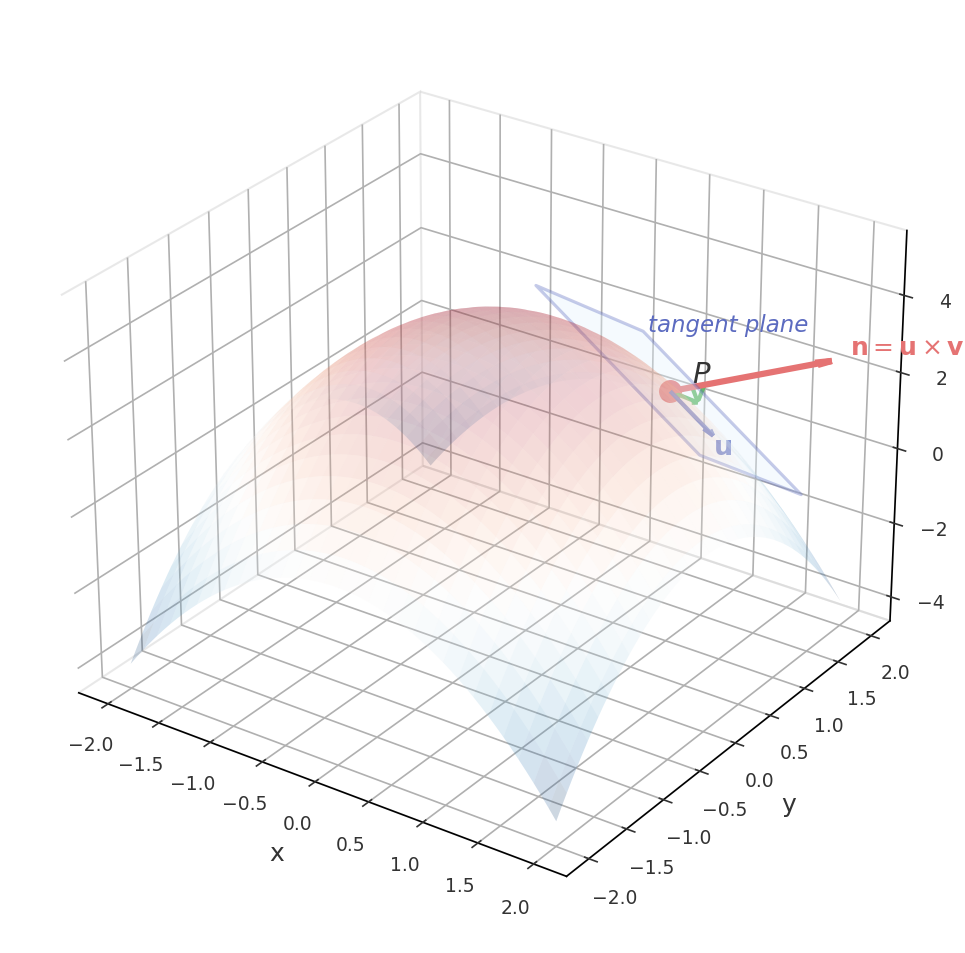
The diagram shows the tangent plane (light blue) at with tangent vectors (blue) and (green) lying in it, and the normal vector (red) pointing perpendicular to the plane.
A normal vector to at is any nonzero vector perpendicular to the tangent plane. Since and span the tangent plane, a normal vector must be orthogonal to both. The cross product produces exactly such a vector.
The cross product of two vectors in is the unique vector perpendicular to both, with magnitude equal to the area of the parallelogram they span. It is computed via a determinant:
Expanding:
The normal vector formula
For a graph surface , the normal vector at any point is
This is not a memorization artifact. It is the cross product of the two coordinate-direction tangent vectors and .
The unit normal vector is obtained by normalizing:
The positive -component means this unit normal points “upward” (away from the -plane). The opposite sign gives the downward-pointing unit normal.
Worked example
Problem. Find the tangent plane and unit normal vector to the surface at the point where .
Step 1: Find the point .
Step 2: Compute partial derivatives at .
Step 3: Write the tangent vectors.
says: moving one unit in the -direction from , the surface drops 2 units. says the same for the -direction. Both point “downhill” because this is the top of an inverted paraboloid.
Step 4: Compute the normal vector.
Step 5: Normalize.
Step 6: Verify orthogonality. The normal must be perpendicular to both tangent vectors:
Step 7: Tangent plane equation.
so .
Why the -direction is different
Why slice with vertical planes ( and ) rather than horizontal planes ()?
The reason is the graph structure. In a graph surface , the variables and are independent and is dependent. Fixing one independent variable and varying the other produces a curve parametrized by a single free variable --- we can differentiate directly.
A horizontal plane imposes the constraint . This defines a level curve of (see Directional Derivatives and the Gradient) --- a curve in the -plane where takes the constant value . To get a tangent vector from a level curve, we would need to parametrize it first (by solving for one variable in terms of the other), and the resulting tangent vector lies in the span of and anyway --- it gives no new information.
Level curves and the tangent plane
Horizontal slices of the surface at height project down to the level curves in the -plane. These are the same level curves that appear in the theory of directional derivatives and the gradient: the gradient is perpendicular to level curves, pointing in the direction of steepest ascent. The tangent plane and normal vector of this note, and the gradient and level curves of that note, are two views of the same geometry --- one from the surface in , the other from its projection in .
Appearance in surface integrals
The normal vector and the quantity appear throughout surface integrals.
Surface area element. The area of a small patch of surface above a rectangle in the -plane is
The factor accounts for the surface being tilted relative to the -plane. A steeper surface (larger partial derivatives) has more area per unit of projected area.
Oriented surface element. For flux integrals (computing how much of a vector field passes through the surface), the relevant quantity is the normal vector scaled by the area element:
The sign corresponds to the choice of upward () or downward () orientation. The normalization factor cancels between and , so the unnormalized normal is often all you need.
See also
- Directional Derivatives and the Gradient --- the gradient as normal to level curves in ; this note extends the idea to surfaces in
- Position Vectors and Coordinate-Free Geometry --- position vectors and affine combinations
- Derivatives, Differentials, and the Chain Rule --- the chain rule used to compute tangent vectors to parametrized curves
- Critical Points and the Hessian --- what happens when (the tangent plane is horizontal): critical points and the second-derivative test