Settlement and Clearing
Recommended reading order
See study-guide for the full two-track learning path. This note is Track A, Step 2 (Phase 1a: Market Fundamentals).
Previous: market-fundamentals — what markets do and who participates. Next: trading-fundamentals — spreads, market makers, adverse selection.
Sources
BIS CPMI-IOSCO, Principles for Financial Market Infrastructures (PFMI, 2012) — the global standard for settlement systems. Harris, Trading and Exchanges, Ch. 6–7. SEC Rule 15c6-1(a) as amended (2023) — the T+1 mandate. Pirrong, The Economics of Central Clearing (ISDA, 2011). See the reference table at the bottom.
Why This Note Exists
The market-fundamentals note introduced the infrastructure stack: exchanges, clearinghouses, CSDs (Central Securities Depositories — the authoritative record of who owns what). But it didn’t explain what happens between you clicking “buy” and actually owning the asset. That gap — and the risks hiding inside it — is the subject of this note.
Understanding the settlement gap also explains why some argue for alternative architectures — atomic settlement eliminates counterparty risk entirely, but sacrifices the capital efficiency that netting provides. The tradeoffs are explored in Atomic Settlement: A Different Architecture below.
The Trade Lifecycle
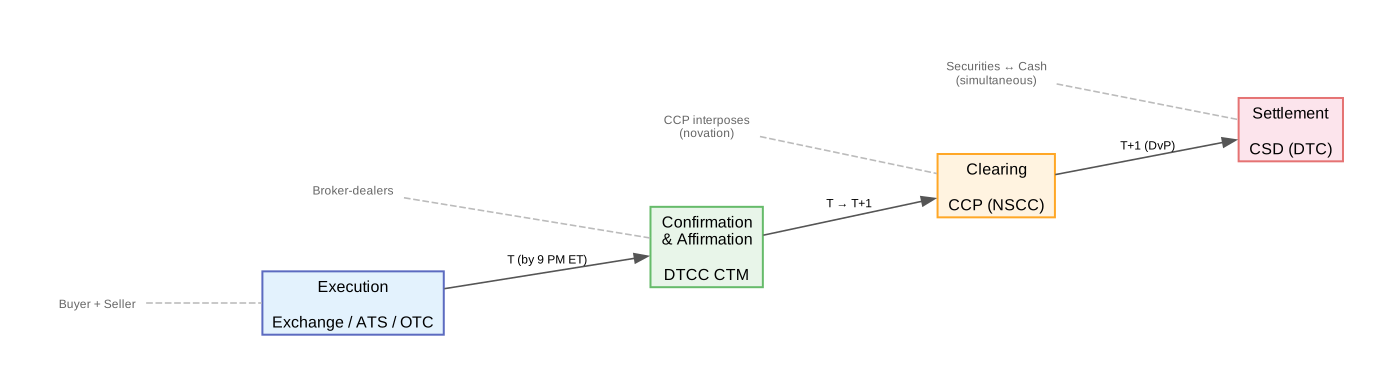 The four stages of a trade, from execution to final settlement. Each
stage has distinct actors, systems, and failure modes.
The four stages of a trade, from execution to final settlement. Each
stage has distinct actors, systems, and failure modes.
Think of the trade lifecycle as a pipeline with four stages:
| Stage | What Happens | Actor | System (US Equities) | Timing |
|---|---|---|---|---|
| Execution | Buyer and seller agree on terms | Exchange / ATS / OTC | NYSE, Nasdaq, etc. | T |
| Confirmation | Both parties verify trade details are correct | Broker-dealers | DTCC CTM | T (by 9 PM ET) |
| Clearing | CCP interposes itself, computes net obligations | CCP | NSCC | T → T+1 |
| Settlement | Securities and cash actually change hands | CSD | DTC | T+1 |
Stage 1 — Execution (T)
A buyer and seller agree on terms: instrument, quantity, price, counterparties. This can happen via:
- Exchange order book — anonymous matching engine, price-time priority (see order-books)
- RFQ (Request for Quote) — buyer asks one or more dealers for a price on a specific size. The dealer quotes; the buyer accepts or rejects. Common in bonds, swaps, structured products (see trading-venues)
- Dark pool — off-exchange venue, no pre-trade transparency
- OTC bilateral — two parties negotiate directly, often with bespoke terms (maturity, notional, covenants) that wouldn’t fit a standard RFQ. Typical for derivatives and illiquid bonds. The difference from RFQ: an RFQ is a protocol (request → quote → accept/reject) that can run on an electronic platform; OTC bilateral is a relationship where two parties negotiate freely, often over chat or phone, with no platform intermediating
The output is a trade record — an immutable event. In distributed systems terms: the execution is the event being produced onto a topic.
For the vocabulary of order types (market orders, limit orders, stop orders) and how they interact with the matching engine, see order-books.
Stage 2 — Confirmation & Affirmation (T to T+evening)
Confirmation = both parties agree the trade details are correct (instrument, quantity, price, settlement date, SSIs — Standard Settlement Instructions, which specify where to deliver securities and cash).
Affirmation = the institutional investor (buy-side) affirms the allocation details — how a block trade is split across the investor’s sub-accounts or funds (e.g., “5,000 shares to the growth fund, 3,000 to the income fund, each with its own SSI”) — provided by its broker (sell-side). Under T+1, DTCC requires affirmation by 9:00 PM ET on trade date — a major operational squeeze vs. the old T+2 regime.
This is the confirmation/ack pattern: the consumer reads the event, validates it, sends an ack. If there’s a mismatch (a DK — “Don’t Know,” the industry term for a trade that one party doesn’t recognize), it goes to an exception queue for manual resolution.
Stage 3 — Clearing (T through settlement)
This is where the CCP (Central Counterparty) interposes itself between buyer and seller through novation — explained in detail below. The CCP validates the trade, performs novation, calculates netting obligations, collects margin, and manages risk until settlement.
For US equities, this is NSCC (National Securities Clearing Corporation, a DTCC subsidiary). Its core system is CNS (Continuous Net Settlement), which nets all of a participant’s trades in each security into a single net long or net short position each day.
Stage 4 — Settlement (T+1)
Settlement = the actual exchange of securities and cash. Final. Irrevocable.
For US equities, settlement happens at DTC (Depository Trust Company, another DTCC subsidiary). DTC holds securities in book-entry form (almost no physical certificates anymore). Settlement is the movement of book entries:
- Securities move from seller’s DTC account → buyer’s DTC account
- Cash moves in the opposite direction via Fedwire (the Federal Reserve’s real-time gross settlement system) or the DTC settlement system
The key principle is DvP — Delivery versus Payment — both legs move simultaneously or neither does.
T+1: Why Settlement Takes a Day
History
| Era | Cycle | Why |
|---|---|---|
| Pre-1995 | T+5 | Physical certificate delivery, manual processes |
| 1995 | T+3 | SEC Rule 15c6-1 |
| 2017 | T+2 | Industry initiative, SEC amendment |
| May 2024 | T+1 | SEC amendment; driven by GameStop episode highlighting liquidity risk |
Most non-US markets remain T+2 (EU, UK, Japan). India moved to T+1 in January 2023 — ahead of the US. China settles some instruments on T+0.
What Happens During the Gap?
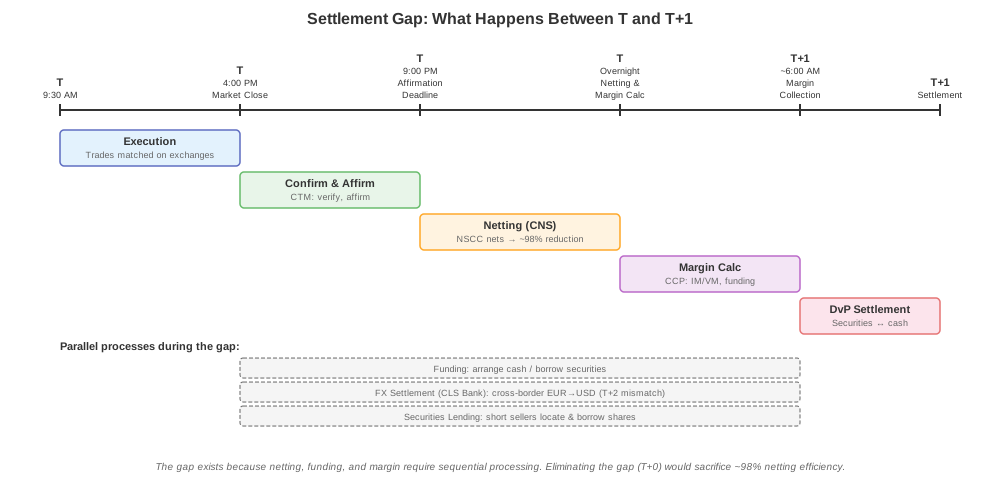 Timeline of the settlement gap: five sequential stages plus three
parallel processes that all must complete before DvP settlement on T+1.
Timeline of the settlement gap: five sequential stages plus three
parallel processes that all must complete before DvP settlement on T+1.
The settlement lag is not laziness — it’s the time needed for real operational work:
-
Netting. NSCC nets all trades executed on T for settlement on T+1. This reduces gross obligations by roughly 98%. On a day with $1 trillion in gross equity trades, the net settlement obligations might be ~$20 billion. Without the gap, you’d lose multilateral netting and need far more liquidity.
-
Funding. Participants arrange cash (or borrow securities) to meet their net obligations. This takes time, especially across time zones.
-
FX settlement for cross-border trades. A European fund buying US equities needs to convert EUR→USD. This FX trade settles via CLS Bank (Continuous Linked Settlement) — the global utility that implements PvP (Payment versus Payment — neither currency leg moves unless both move, the FX equivalent of DvP) for 18 currencies. CLS settles FX on T+2 for most currency pairs, creating a mismatch with T+1 equity settlement that remains an active pain point. See CLS Bank — PvP for Foreign Exchange below for the full mechanism.
-
Margin calculation and collection. The CCP calculates margin obligations overnight and collects them the morning of T+1.
-
Securities lending. Short sellers need to locate and borrow shares. Market makers need to source inventory.
Key insight: Each reduction in the settlement cycle (T+3 → T+2 → T+1) requires significant compression of these processes. T+0 would require a fundamentally different architecture — which is exactly where DeFi enters the conversation.
Delivery versus Payment (DvP)
The Problem: Herstatt Risk
On June 26, 1974, German regulators closed Bankhaus Herstatt at 3:30 PM CET — after the close of the German interbank payment system but before the US payment system closed. Herstatt’s counterparties had already paid Deutsche Marks in Frankfurt but had not yet received the corresponding US dollars in New York.
Result: counterparties lost the full principal amount of their trades. Not a mark-to-market loss — the entire notional. This is principal risk (or Herstatt risk): the risk that you deliver your leg of a transaction but never receive the other leg.
The BIS PFMI (Principles for Financial Market Infrastructures — the global regulatory standard for settlement systems, CCPs, CSDs, and payment systems, published by the Bank for International Settlements in 2012) addresses this directly in Principle 12:
“An FMI (Financial Market Infrastructure) that is an exchange-of-value settlement system should eliminate principal risk by ensuring that the final settlement of one obligation occurs if and only if the final settlement of the linked obligation also occurs.”
How DvP Works
DvP comes in three models (classified by BIS, 1992):
| Model | Securities | Cash | How |
|---|---|---|---|
| Model 1 | Gross (one-by-one) | Gross | Every trade settles individually — no netting |
| Model 2 | Gross | Net | Securities move per-trade; cash settles as a single net payment |
| Model 3 | Net | Net | Both legs are netted; only net positions settle |
NSCC/DTC uses Model 3 (net/net): NSCC nets all trades via CNS, then instructs DTC to move the net securities — the single aggregated position per security after offsetting all buys against all sells for each participant — and net cash simultaneously. The atomic unit is the net position, not the individual trade.
Why net securities (Model 3) instead of gross securities (Model 2)? Model 2 makes intuitive sense for a single buy — you bought AAPL, you receive AAPL. But market makers and broker-dealers trade the same security hundreds of times per day on both sides. A market maker might buy 50,000 shares of AAPL across 200 trades and sell 48,000 shares across 180 trades. Under Model 2 (gross securities), DTC would process all 380 individual deliveries. Under Model 3 (net securities), the market maker receives a single delivery of 2,000 net shares. This matters because each delivery instruction has operational cost and can fail independently — fewer instructions means fewer failure points and less liquidity needed.
Model 2 is used in government bond markets (Fedwire Securities) where trade sizes are large and netting benefits are smaller, because participants tend to be on one side of the market (dealers accumulate inventory from auctions, then distribute).
The mechanical guarantee: DTC’s settlement system will not release securities from a seller’s account unless the corresponding cash is debited from the buyer’s account in the same processing cycle. If either side can’t deliver, the entire instruction fails and recycles.
Central Counterparty (CCP) Clearing
Novation
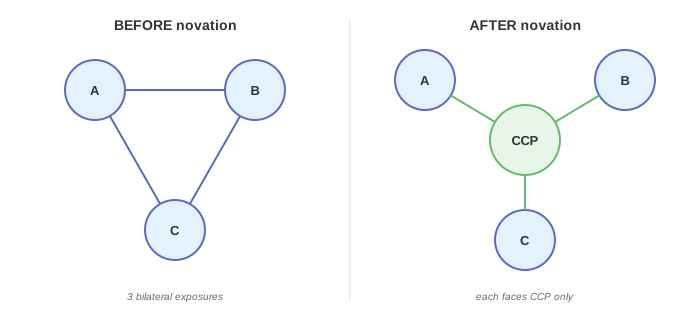 Before novation: each participant has bilateral exposure to every
counterparty (full mesh). After novation: each participant faces only
the CCP (hub-and-spoke).
Before novation: each participant has bilateral exposure to every
counterparty (full mesh). After novation: each participant faces only
the CCP (hub-and-spoke).
When a trade is “cleared,” the CCP performs novation: it legally extinguishes the original bilateral contract between buyer and seller and replaces it with two new contracts — one between the buyer and the CCP, one between the CCP and the seller.
The CCP is now buyer to every seller and seller to every buyer. Each participant only has credit exposure to the CCP, not to hundreds of individual counterparties. In distributed systems terms, the CCP is a centralized broker that guarantees delivery — it absorbs counterparty risk the way a durable queue absorbs producer/consumer decoupling.
Netting
Netting is the CCP’s superpower. Two types:
Bilateral netting: If A owes B $10M and B owes A $7M, the net obligation is A→B $3M.
Multilateral netting: The CCP computes each participant’s net position against ALL other participants simultaneously.
Worked example — five trades between three participants:
| Trade | Buyer | Seller | Amount |
|---|---|---|---|
| 1 | A | B | $100 |
| 2 | B | C | $80 |
| 3 | C | A | $60 |
| 4 | A | C | $40 |
| 5 | B | A | $30 |
Gross obligations: $310 total.
| Participant | Buys (pays) | Sells (receives) | Net |
|---|---|---|---|
| A | $140 (trades 1, 4) | $90 (trades 3, 5) | Pays $50 |
| B | $110 (trades 2, 5) | $100 (trade 1) | Pays $10 |
| C | $60 (trade 3) | $120 (trades 2, 4) | Receives $60 |
Net settlement: $60 in cash moves (A pays 50, B pays 10, C receives 60) vs. $310 gross — an 81% reduction. In practice, NSCC reports ~98% reduction for US equities across thousands of participants.
Margin
The CCP manages its risk through margin — collateral posted by clearing members:
Initial Margin (IM): Posted at trade inception. Covers the CCP’s potential future exposure if a member defaults. Typically calibrated to cover a 2-day liquidation period at a 99% confidence level (per PFMI Principle 6). Returned when the position is closed.
Variation Margin (VM): Collected/paid daily (or intraday during stress). Reflects the mark-to-market change in the portfolio. If your position moved against you by $5M today, you pay $5M in VM tonight. VM ensures losses are crystallized daily, preventing accumulation.
Scope of margin. CCP margin applies to every product that is centrally cleared — this includes equities, listed options, futures, and (post-Dodd-Frank) standardized OTC derivatives. For US equities, NSCC collects margin from clearing members to cover the settlement gap (T to T+1). For derivatives (futures, options), the CCP collects both IM and VM because positions are held open across multiple days. This CCP margin is different from the margin a broker collects from a retail client: broker margin (Regulation T in the US) governs how much a client can borrow to buy securities; CCP margin governs how much collateral clearing members must post to guarantee settlement. The two systems are layered: the broker posts margin to the CCP, and the client posts margin to the broker.
GameStop and margin
The January 2021 GameStop episode illustrates why this matters. NSCC raised margin requirements on clearing members processing heavy GME volume, which forced Robinhood (whose clearing arm was an NSCC member) to restrict trading. The T+2 settlement cycle at the time amplified the requirement because NSCC was exposed for 2 days of potential price moves. Moving to T+1 directly reduced CCP margin requirements — DTCC estimated a ~$4–5 billion reduction.
Default Waterfall
If a clearing member defaults, the CCP absorbs losses in a defined sequence:
- Defaulter’s initial margin — first line of defense
- Defaulter’s default fund contribution
- CCP’s own capital (“skin in the game” — placed before mutualized losses to align the CCP’s incentives with sound risk management)
- Non-defaulting members’ default fund contributions (mutualized)
- Additional assessments on surviving members
- CCP resolution / “tear-up” of contracts (nuclear option)
This waterfall is codified in each CCP’s rulebook and supervised under PFMI Principles 4 (credit risk) and 7 (liquidity risk).
Major CCPs
| CCP | Products | Jurisdiction |
|---|---|---|
| NSCC (DTCC) | US equities, corporate bonds | US |
| OCC | US listed options | US |
| CME Clearing | Futures, options on futures, some OTC | US |
| LCH (LSEG) | Interest rate swaps (largest IRS CCP globally), FX, bonds | UK / EU |
Post-2008, the Dodd-Frank Act (US) and EMIR (EU) mandated central clearing for standardized OTC derivatives. This was a direct response to the 2008 crisis: AIG had sold massive volumes of credit default swaps (CDS — insurance-like contracts that pay out if a bond defaults) on mortgage-backed securities, all bilaterally with no CCP and no transparency. When the housing market collapsed, AIG owed tens of billions in CDS payouts it couldn’t cover, threatening every bank that had bought CDS protection from AIG. The US government bailed out AIG for $182 billion to prevent cascading defaults. See aig-and-the-cds-crisis for the full story.
The tradeoff: mandatory clearing makes CCPs themselves systemically important (designated SIFMUs — Systemically Important Financial Market Utilities — in the US), receiving both enhanced supervision and central bank backstops. The risk didn’t disappear — it concentrated.
Settlement Fails
A settlement fail occurs when one party does not deliver its obligation on the contractual settlement date. The trade doesn’t disappear — it recycles and settles the next day, or the next, until resolved.
Common causes: operational errors (wrong SSIs, mismatched details), short selling without locating shares, chains of fails (A can’t deliver to B because C didn’t deliver to A), and deliberate strategic fails when the cost of failing is cheaper than borrowing scarce securities.
Roughly 2% of US equity trades fail on the intended settlement date. On a $1 trillion gross trade day, that’s $20 billion in unsettled obligations. Multiple penalty regimes discourage this: SEC Regulation SHO (Short selling and delivery obligations regulation — “SHO” stands for “Short selling,” the regulation’s informal name from its 2005 adoption) mandates close-out of fails-to-deliver within days, and NSCC charges escalating fees for persistent fails.
The interesting thing about fails is what they reveal: TradFi settlement is probabilistic, not deterministic. The system is designed to tolerate some failure and resolve it through economic penalties, rather than preventing it architecturally. This is a profound contrast with DeFi.
CLS Bank — PvP for Foreign Exchange
If DvP is the atomic swap for securities-against-cash (neither leg moves unless both move), PvP (Payment versus Payment) is the same idea for currency-against-currency. CLS Bank International is the global utility that implements PvP for FX — settling ~$6 trillion per day across 18 currencies. In distributed-systems terms, CLS is a two-phase commit coordinator across 18 central-bank RTGS (Real-Time Gross Settlement) systems, with a funding-efficiency layer that reduces actual cash movements by 96–99%.
Why CLS Exists: The Herstatt Story
The Herstatt failure of June 1974 created the problem CLS was built to solve. On that day, counterparties had irrevocably paid Deutsche Marks in Frankfurt but never received the corresponding US dollars in New York — losing the full principal amount (~$620M at the time, per BIS estimates). The generic problem was named Herstatt risk (also called FX settlement risk or cross-currency settlement risk): the risk that you deliver your currency leg but never receive the other, because the two legs settle in two different jurisdictions on two different timelines.
The BIS tracked this problem for two decades. The canonical report is CPSS, Settlement Risk in Foreign Exchange Transactions (the “Allsopp Report,” March 1996), which defined the lifecycle of settlement exposure and laid out a three-track strategy: bank-level risk management, multi-currency netting, and — eventually — a PvP utility. That strategy became CLS, which went live on 9 September 2002 with seven currencies.
Legal Architecture
CLS Bank International is an Edge Act bank (a type of US-chartered bank permitted to engage in international banking transactions) in New York, supervised by the Federal Reserve. It holds a cash account at each of the 18 central banks whose currency it settles. Each Settlement Member (~70 of the largest FX dealers) holds a single multi-currency account at CLS, logically split into 18 sub-accounts (one per currency).
When a member pays CLS in EUR, what happens physically: the member sends EUR through TARGET2 (the Eurosystem’s RTGS) to CLS’s EUR account at the ECB, and CLS credits the member’s EUR sub-account on its own books. When CLS pays out, the reverse — central bank money moves out of CLS’s central-bank account.
The Daily Cycle: The 5-Hour Funding Window
All times are CET:
| Time | Event |
|---|---|
| Up to 00:00 | Members submit matched instructions (cut-off = midnight CET on settlement day) |
| 00:00 | Initial Pay-In Schedule (IPIS) published: per-member, per-currency net short amounts |
| 06:30 | Revised Pay-In Schedule (RPIS) published (after any late amendments) |
| 07:00 | Settlement session starts — trades settled on CLS books |
| 07:00–09:00 | Settlement session (2 hours) |
| 09:00 | Target for settlement completion |
| 10:00 | Pay-in/pay-out deadline for early-closing currencies (APAC: JPY, AUD, NZD, HKD, SGD, KRW) |
| 12:00 | Pay-in/pay-out deadline for late-closing currencies (EUR, GBP, USD, CAD, CHF, DKK, NOK, SEK, ZAR, MXN, ILS, HUF) |
The “5-hour funding window” is 07:00–12:00 CET, during which pay-ins and pay-outs flow. APAC currencies have a narrower 3-hour window (07:00–10:00) because their domestic RTGS systems close earlier. The overlap of all 18 RTGS systems is narrow — CLS required central banks to extend operating hours, a significant political lift in 2002.
Two Layers: Settlement vs Funding
These two layers are distinct — conflating them is the usual source of confusion.
Layer 1 — Settlement on CLS books (07:00–09:00). Each matched FX trade is settled gross as two simultaneous book entries in CLS’s internal ledger. For an EUR/USD trade between Member A and Member B:
- A’s USD sub-account debited, B’s USD sub-account credited, AND
- A’s EUR sub-account credited, B’s EUR sub-account debited
Both entries are atomic — the unit of commit is the trade itself. This is where PvP lives. No principal risk is possible because there is no state in which one entry occurs without the other.
Before committing a trade, CLS runs three risk tests on both counterparties’ resulting positions:
- Positive Adjusted Account Balance (AAB): The sum across all 18 sub-accounts, converted to USD at haircut-adjusted FX rates, must be ≥ 0. Haircuts (currently 2–15% per currency) provide a collateral cushion against intraday FX moves.
- Short Position Limit (SPL): Each currency sub-account has a floor — a maximum allowed short position per currency.
- Aggregate Short Position Limit (ASPL): The aggregate of all short positions (USD-equivalent) is capped at a member-specific limit based on credit quality.
If a trade would breach any test, the algorithm defers it and tries another queued trade. This is a constrained scheduling problem — similar in spirit to the liquidity-saving mechanisms used in CHAPS and TARGET2.
Layer 2 — Funding (07:00–12:00). This is where the 5-hour window matters operationally. Two properties make CLS economically viable:
-
Multilateral netting. Members don’t fund gross flows. They fund only their net position per currency across all trades with all CLS members that day. Typical funding efficiency: ~96–99%. On a day with 50–80B in central-bank money. Without this netting, there would not be enough intraday liquidity on the planet.
-
Recycling. Pay-ins happen in tranches during the window. As soon as CLS receives an inflow in currency X, it can pay out currency Y to a member who is net long Y — and that member can then pay in their net short in currency Z. Cash recycles through the system, further reducing peak funding requirements.
Why CLS Matters for T+1
CLS settles FX on T+2 for most currency pairs. US equities settle on T+1. A European fund buying US equities must convert EUR→USD, but the FX leg settles a day after the equity leg. The fund needs USD before its FX trade settles — requiring pre-funding or intraday credit lines. This mismatch is the biggest operational challenge of T+1 for cross-border investors.
Atomic Settlement: A Different Architecture
An alternative to deferred settlement is atomic settlement — where execution and settlement happen in the same instant. If either leg fails, the entire transaction reverts. DvP is enforced by the execution environment itself, not by institutional trust.
| Property | Deferred settlement (TradFi) | Atomic settlement |
|---|---|---|
| Timing | T+1 / T+2 | T+0 (instantaneous) |
| DvP enforcement | Institutional (CSD rules, CCP guarantees) | Architectural (transaction reverts on failure) |
| Counterparty risk | Managed by CCP (novation + margin) | Eliminated — succeeds or reverts |
| Netting | Multilateral, ~98% reduction | None — every trade settles gross |
| Settlement fails | ~2% fail rate, penalty regime | Impossible by design |
| Capital efficiency | High (netting reduces obligations) | Low (every trade needs full prefunding) |
The fundamental tradeoff: atomic settlement eliminates counterparty risk and settlement fails, but sacrifices the capital efficiency that comes from netting. On a $1 trillion gross trade day, NSCC’s multilateral netting reduces obligations by ~98%. Without netting, every trade requires full prefunding — orders of magnitude more capital.
Hybrid architectures (DTCC’s Digital Securities Management, the Canton Network, Fnality) try to get atomic settlement AND netting by creating short batching windows (minutes instead of hours). The open question: can you shrink the netting window without losing the netting benefit?
For how blockchain-based systems implement atomic settlement, see blockchain-transaction-lifecycle and constant-product-amm.
Source Summary
| Source | Covers |
|---|---|
| BIS CPMI-IOSCO, PFMI (2012) | Global standards: Principles 7 (finality), 9 (money settlements), 12 (DvP) |
| Harris, Trading and Exchanges, Ch. 6–7 | Practitioner-accessible clearing and settlement treatment |
| SEC Rule 15c6-1(a) (amended 2023) | The T+1 mandate (Release No. 34-96930) |
| SEC Regulation SHO, Rule 204 | Close-out requirements for fails-to-deliver |
| Pirrong, The Economics of Central Clearing (ISDA, 2011) | CCP tradeoffs, economics of netting |
| DTCC, T+1 Settlement Resources | Implementation guides, margin impact estimates |
| CPSS, Settlement Risk in Foreign Exchange Transactions (1996) | The “Allsopp Report” — Herstatt risk lifecycle, strategy leading to CLS |
| BIS, Quarterly Review (Dec 2019) | “The Herstatt lessons and after” — historical context |
| CLS Bank, Settlement Process documentation | PvP mechanism, daily cycle, risk tests, funding efficiency |
Questions and answers:
Q1. Moving from T+2 to T+1 reduced NSCC margin requirements by billions. Why?
Initial margin is calibrated to cover the CCP’s potential loss if it must liquidate a defaulter’s portfolio. The key parameter is the liquidation horizon — how long the CCP is exposed before it can close out the position. Under T+2, the CCP is exposed for 2 days; under T+1, for 1 day.
The margin model asks: what is the worst-case portfolio loss over the liquidation horizon at a given confidence level? CCPs typically use a 99% confidence level (PFMI Principle 6), meaning the margin should cover 99% of possible loss scenarios. The potential loss scales with the square root of time (for normally-distributed returns): a 2-day horizon has √2 ≈ 1.41× the volatility of a 1-day horizon. Cutting from T+2 to T+1 reduces the margin requirement by roughly 29% (1 − 1/√2).
Confidence level in risk management
A 99% confidence level here means: the CCP estimates the distribution of possible portfolio losses over the liquidation horizon (using historical simulation, parametric VaR (Value at Risk — the loss threshold at a given confidence level), or stress scenarios), then sets margin at the 99th percentile. The 1% tail — the scenarios where losses exceed margin — is covered by the default fund and waterfall. See confidence-levels-in-risk for the full treatment (how VaR relates to confidence intervals, the limitations of assuming normal distributions, and why CCPs supplement VaR with stress testing).
Q2. Designing a decentralized system with netting AND atomic DvP — what tradeoff are you forced to make?
Netting requires batching — collecting trades over a time window, computing net positions, then settling the nets. Real-time gross settlement (RTGS) settles each trade immediately and individually. You cannot net trades that haven’t happened yet, so netting fundamentally requires a delay — a settlement window during which trades accumulate.
The architectural tradeoff: you must choose between immediacy (T+0 atomic settlement, no counterparty risk, but every trade settles gross and requires full prefunding) and capital efficiency (deferred settlement with netting, ~98% reduction in obligations, but you reintroduce a settlement gap and counterparty risk during that gap).
Hybrid designs (Canton Network, Fnality) try to split the difference by creating short batching windows (minutes instead of hours) with on-chain netting. The open question is whether the netting benefit degrades gracefully as the window shrinks, or whether there’s a minimum batch size below which netting doesn’t help.
Q3. A European pension fund buys US equities under T+1 — what operational problem?
The fund must affirm the trade and arrange EUR→USD conversion by 9 PM ET on trade date. 9 PM ET = 3 AM CET — the middle of the night in Europe. Under T+2, European operations had the full next business day to complete affirmation and FX; under T+1, they must either staff overnight desks or automate these processes to meet the US deadline. The FX mismatch makes it worse: CLS Bank settles most FX on T+2 (see CLS Bank — PvP for Foreign Exchange), so the fund needs USD before its FX trade settles, requiring pre-funding or intraday credit lines.
Q4. Why does the CCP place its own capital before non-defaulting members’ contributions?
This is a skin-in-the-game mechanism. If the CCP’s own money is at risk before it can mutualize losses across members, the CCP has a direct financial incentive to:
- Set margin requirements conservatively (not too low to attract volume)
- Monitor member creditworthiness rigorously
- Act quickly on deteriorating positions
Without this, the CCP could take excessive risk knowing that members bear the losses. It aligns the CCP’s incentives with prudent risk management — the same principle as a fund manager co-investing in their own fund.
See also
- market-fundamentals — the previous note: what markets do, asset classes, participants
- trading-fundamentals — the next note: spreads, market makers, adverse selection
- blockchain-transaction-lifecycle — how on-chain transactions travel from wallet to block
- constant-product-amm — the AMM math behind atomic DeFi swaps
- trade-types — agency vs principal, block trades, algorithmic execution, PFOF
- trading-venues — dark pools, PFOF, RFQ, and the venue landscape
- ipo-process — the IPO lifecycle, underwriting, and greenshoe mechanics