LP Profitability — Fees vs Impermanent Loss
A rational liquidity provider cares about one thing: net P&L. The LP earns fee income from every swap and loses to impermanent loss as the price moves. Profitability reduces to a race between these two forces.
This article builds a simple model of each component and derives the break-even condition.
The LP’s Dilemma in Plain English
If you deposit tokens into an AMM pool, you earn a cut of every trading fee. But every time the token’s price moves, you lose value compared to just holding — this is impermanent loss (see impermanent-loss). The central question: do the fees you earn outweigh the losses from price movement?
It depends on two things: (a) how much trading volume flows through the pool (more volume = more fees), and (b) how much the price moves (more movement = more IL). If the token trades heavily but the price stays roughly stable, LPs profit. If the price crashes — as memecoins typically do — the IL dwarfs the fees.
The math below builds a precise model of when LPs break even. It is the DeFi equivalent of asking “what implied volatility makes a short straddle profitable?” from options theory (see options-basics for straddles and volatility for the realized/implied distinction).
Prerequisites
This note assumes familiarity with constant-product-amm and impermanent-loss. The math uses summation notation and variance. If you know the short straddle analogy from options — LPs are short vol, fees are premium collected — you have the right intuition already.
Fee Income Model
Per-Swap Fees
Each swap through the pool pays a fee (e.g., 0.30% for Uniswap V2, 0.25% for PumpSwap). If a swap has notional size (measured in the output token), the fee is .
Over a period with swaps, total fees collected by the pool are:
where is total trading volume through the pool.
Fee Yield for a Single LP
An LP owning fraction of the pool earns:
Expressed as a return on the LP’s capital :
The cancels — fee yield depends only on the volume-to-liquidity ratio , often called pool utilization or turnover.
Annualized Fee APR
If daily volume is and pool TVL is :
For a pool with , daily volume = $10M, and liquidity = $50M:
This is the gross yield before IL.
Impermanent Loss as a Cost Rate
From impermanent-loss, IL over a period where price moves by ratio is:
For small log-price moves over a short interval :
where is the realized variance of the log-price over that interval.
Over a longer horizon with annualized volatility :
(This uses the property that log-price variance scales linearly with time under a diffusion model.)
Break-Even Condition
The LP breaks even when fee income equals IL:
Solving for the maximum tolerable volatility:
Or equivalently, the minimum volume needed to offset a given volatility:
Numerical Example
Pool parameters: , daily volume = $10M, liquidity = $50M.
This pool can tolerate annualized volatility up to 132% before IL exceeds fee income. That is quite high — ETH/USDC realized vol is typically 60—100%, so this pool would likely be profitable.
Now consider a thin pool: daily volume = $100K, liquidity = $5M:
This pool can only tolerate 13.2% annual vol — far below typical crypto volatility. LPs here are almost certainly losing money.
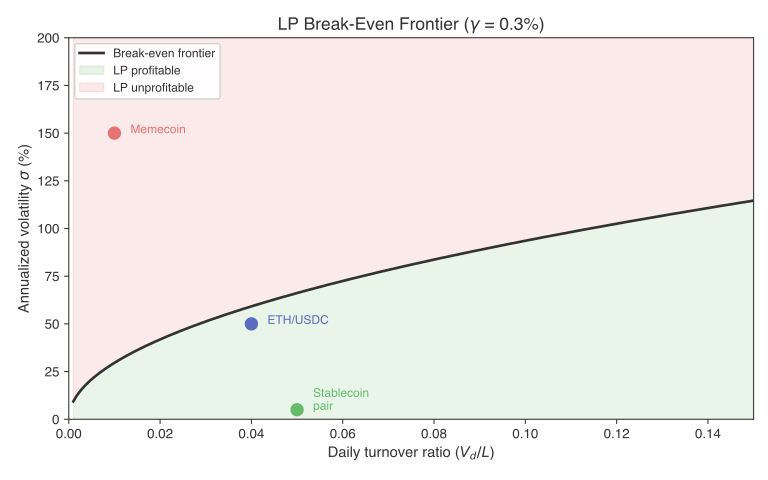 The break-even frontier: combinations of fee rate, volume/TVL, and volatility where LP P&L = 0.
The Profitability Quadrant
LP profitability maps onto a two-dimensional space:
| High volume / TVL | Low volume / TVL | |
|---|---|---|
| Low volatility | Very profitable | Marginally profitable |
| High volatility | Depends on ratio | Unprofitable |
The best LP positions are in high-turnover, low-volatility pools: stablecoin pairs (USDC/USDT), or major pairs during calm markets.
The worst are low-turnover, high-volatility pools: long-tail meme tokens with thin liquidity and violent price swings. These are exactly the tokens that attract retail LPs with headline APR numbers computed from a single day’s volume.
Dynamic Considerations
The simple model above assumes constant , , and . Reality is messier:
Volume chases volatility
When price moves sharply, arbitrage volume spikes. This creates a partial natural hedge: the same volatility that causes IL also generates fee income. The question is whether the hedge ratio is sufficient — empirically, for most pools, it is not. Arbitrage volume covers only a fraction of the IL.
LP capital is mobile
When a pool becomes unprofitable, LPs withdraw, shrinking . This increases the fee yield ( rises) and increases price impact (which may reduce arbitrage volume). The pool finds a new equilibrium with less liquidity and higher yield. This is analogous to market makers widening spreads in volatile conditions in TradFi — see market-microstructure.
Fee tiers segment the market
Uniswap V3 offers multiple fee tiers (1 bps, 5 bps, 30 bps, 100 bps). Pairs naturally sort by volatility: stablecoins at 1 bps, blue-chip pairs at 5—30 bps, long-tail at 100 bps. This is the AMM analogue of tick-size tiering in equity markets.
The Market-Maker Analogy
The LP’s P&L equation is structurally identical to a traditional market maker’s:
| TradFi market maker | AMM liquidity provider |
|---|---|
| Earns the bid-ask spread | Earns swap fees |
| Loses to informed flow (adverse selection) | Loses to arbitrageurs (IL) |
| Profits when vol is low, flow is retail | Profits when vol is low, volume is high |
| Widens spreads in volatile markets | Fee tier selection; LP withdrawal |
The key difference: a TradFi market maker can choose which orders to fill and dynamically adjust quotes. An AMM LP is passive — the pricing function is fixed, and the LP cannot discriminate between informed and uninformed flow. This structural disadvantage is why IL is such a persistent drag.
Connection to Volatility
The break-even formula defines a critical volatility threshold:
This is the LP’s implied volatility — the market’s forecast of future vol, embedded in the pool’s fee structure. The LP is profitable when realized volatility stays below this threshold.
The parallel to options is precise: an option seller collects a premium that embeds the market’s implied vol. If realized vol comes in lower, the seller profits. The LP’s fee income plays exactly this role. For the formal definition of realized and implied volatility, and the volatility risk premium (the empirical tendency of implied vol to exceed realized vol), see volatility.
Practical application: ETH’s realized vol typically ranges 60–100%. If the break-even vol for an ETH/USDC pool is 132%, the LP is comfortable. If it’s 40%, the LP is likely losing. Memecoins with 200–500% realized vol require extremely high fee × volume combinations to be profitable.
Companion notebook: notebook — interactive break-even frontier, profitability heatmap across , and fee-vs-IL race simulation.
Questions to sit with:
- The break-even formula gives . All else equal, doubling the fee rate increases tolerable volatility by only . Why does the square root appear — what is the deeper reason?
- If arbitrage volume partially offsets IL, could you model the net effect as a “fee-adjusted volatility” ? What data would you need to estimate ?
- An LP in a Uniswap V3 concentrated-liquidity position earns higher fees per dollar of capital but faces higher IL (the position is more leveraged). Does concentration change the break-even condition, or does it cancel out?