Trading Venues
Prerequisites
- market-fundamentals — asset classes, market participants, order-driven vs quote-driven markets
- settlement-and-clearing — what happens after a trade executes
Why this is confusing
The vocabulary around trading venues is genuinely messy because:
- Terminology evolved faster than regulation. “Dark pool” is a market term, not a legal category. “RFQ” is a protocol that runs on top of different venue types.
- The US and EU drew the lines in different places. The US has two categories (exchange vs ATS). The EU has four (RM, MTF, OTF, SI). The mapping is not one-to-one. venue-taxonomy-divergence explains why.
- “Where” and “how” are different questions. A trade can execute on an exchange (where) using an RFQ protocol (how). These are orthogonal dimensions, but people conflate them.
This note untangles the taxonomy, defines each term precisely, and explains the relationships that trip people up.
Taxonomy at a glance
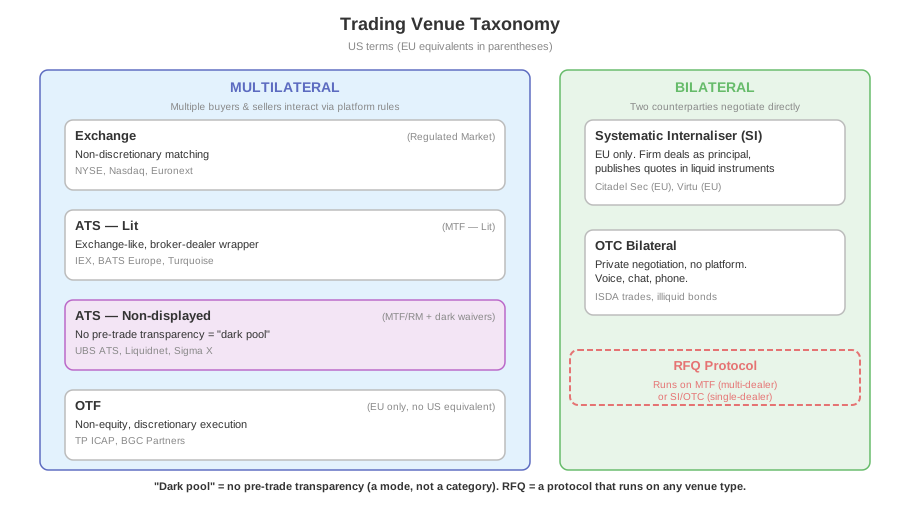
Left: multilateral venues where platform rules govern matching. Right: bilateral execution between two counterparties. The dashed RFQ box spans both — it’s a protocol that runs on any venue type. The purple-highlighted box is the “dark pool” — a multilateral venue without pre-trade transparency.
The core distinction: multilateral vs bilateral
Every trade execution falls on one side of this line:
- Multilateral — multiple buyers and sellers interact on a platform with rules governing how orders match. The venue operator is a neutral intermediary.
- Bilateral — two specific counterparties negotiate directly. One of them is typically a dealer acting as principal (trading from their own book).
Regulators in both the US and EU build their entire venue taxonomy on this distinction. Everything else is refinement.
Venue types
Exchange (US) / Regulated Market (EU)
US — Exchange: Defined in §3(a)(1) of the Securities Exchange Act of 1934, expanded by Rule 3b-16 (17 CFR §240.3b-16). An organization is functionally an exchange if it:
- Brings together orders of multiple buyers and sellers, and
- Uses established, non-discretionary methods under which orders interact
That Rule 3b-16 functional test is the key — it’s why an ATS “would be” an exchange but for the Reg ATS exemption. NYSE, Nasdaq, CBOE are all registered as national securities exchanges under §6 of the Exchange Act.
EU — Regulated Market (RM): MiFID II Art. 4(1)(21). A multilateral system operated by a market operator that brings together buying/selling interests “in accordance with non-discretionary rules” resulting in a contract. Must be authorized and supervised. Examples: Euronext, Deutsche Börse, LSE main market.
Shared DNA: multilateral + non-discretionary + rule-based.
ATS (US) / MTF (EU)
US — Alternative Trading System: Reg ATS, 17 CFR §§242.300–304. An ATS meets the Rule 3b-16 exchange definition but chooses to register as a broker-dealer instead of an exchange, complying with Reg ATS. Must file Form ATS (Form ATS-N for NMS stocks, post-2018). An ATS cannot:
- Set rules governing subscribers’ conduct beyond system usage
- Discipline subscribers (other than excluding them)
In other words: an ATS is an exchange-like venue running under a broker-dealer wrapper. Lighter regulatory load, but less ability to set conduct rules.
EU — Multilateral Trading Facility (MTF): MiFID II Art. 4(1)(22). Nearly identical to the RM definition — multilateral, non-discretionary, results in a contract. The difference is operational: MTFs can be run by investment firms (not just market operators), have lighter admission rules, and were the vehicle for competition against incumbent exchanges (Chi-X, Turquoise, BATS Europe).
OTF (EU only — no US analogue)
MiFID II Art. 4(1)(23). A multilateral system for non-equity instruments only (bonds, structured finance, emission allowances, derivatives) where buying/selling interests interact in a way that results in a contract. Three crucial distinctions:
- Non-equity only. OTFs cannot trade shares, ETFs, or depositary receipts.
- Discretionary execution is permitted (Art. 20). The operator can decide whether to place/retract orders and whether to match specific client orders.
- Operators cannot deal on own account (matched principal only, with client consent — Art. 20(2)). Prevents OTFs from becoming SIs-in-disguise.
OTFs were created by MiFID II (2018) to capture voice-brokered and hybrid bond/derivative venues (e.g., inter-dealer brokers like TP ICAP, BGC) that didn’t fit the non-discretionary MTF model.
Systematic Internaliser (SI) — EU only
MiFID II Art. 4(1)(20). An investment firm that, on an organised, frequent, systematic, and substantial basis, deals on own account when executing client orders outside any multilateral venue.
Key features:
- Bilateral — firm vs client, not multilateral
- Firm deals as principal — it’s a dealer, not an agent
- Quantitative thresholds for “frequent/systematic/substantial” defined in Commission Delegated Regulation (EU) 2017/565, Art. 12–15
- Pre-trade transparency: SIs must publish firm quotes in liquid instruments (MiFIR Art. 14 for equities, Art. 18 for non-equities)
No direct US equivalent. The closest concept is a broker-dealer internalizing order flow — wholesalers like Citadel Securities and Virtu running OTC market-making for retail flow. But US internalizers aren’t a distinct venue type; they’re broker-dealers subject to Reg NMS best execution and Rule 605/606 disclosures.
OTC bilateral
Not a venue type — a transaction type. An OTC bilateral trade is executed directly between two counterparties without any multilateral venue. Terms negotiated privately (voice, chat, email, phone).
Governed by:
- Derivatives: bilateral ISDA master agreements
- US post-trade reporting: FINRA TRACE (bonds), FINRA TRF/ORF (equities), CFTC SDR (swaps)
- EU post-trade reporting: MiFIR Art. 21, via APAs (Approved Publication Arrangements)
In the EU, a trade that is “truly OTC” (not on RM/MTF/OTF) is either on an SI (if the dealer is SI-registered in that instrument) or a pure bilateral trade. The SI regime was designed to pull internalized flow into a regulated framework rather than let it vanish into the OTC bucket.
Dark pools — a mode, not a category
No formal regulatory definition
“Dark pool” is a market term. There is no legal definition of “dark pool” in either US or EU securities law.
Operationally, a dark pool is any venue or mode that does not display quotes pre-trade (no pre-trade transparency). The mechanics differ by jurisdiction:
US: A dark pool is almost always a non-displayed ATS — an ATS that doesn’t publish bid/offer. Operates under the same Reg ATS framework as “lit” ATSs. Post-2018, Form ATS-N requires disclosure of order types, matching logic, and conflicts of interest. Examples: UBS ATS, MS Pool, Liquidnet, Sigma X. IEX is a hybrid — lit exchange with a speed bump.
EU: “Dark trading” happens on MTFs or RMs using pre-trade transparency waivers under MiFIR Art. 4:
| Waiver | Mechanism |
|---|---|
| Reference price waiver (RPW) | Match at midpoint of a reference market |
| Negotiated trade waiver | Bilateral negotiation within the venue |
| Large-in-scale (LIS) waiver | Orders above a size threshold |
| Order management facility | E.g., iceberg orders that hide true size |
These waivers were historically subject to the Double Volume Cap (MiFIR Art. 5) limiting dark trading volume — revised to a Single Volume Cap in the MiFIR Review (2024).
Key insight: “dark pool” describes a mode of operation (no pre-trade transparency), not a venue category. In the US it’s nearly always an ATS. In the EU it’s a waiver-based mode on an existing MTF or RM.
RFQ — a protocol, not a venue
Request for Quote is an execution protocol: a client sends an inquiry (instrument, size, direction) to one or more dealers, who respond with prices. The client accepts one (or none).
RFQ protocols run on top of various venue types:
| Configuration | Venue type | Example |
|---|---|---|
| Multi-dealer RFQ (≥2 respondents) | MTF | Tradeweb, Bloomberg MTF, MarketAxess |
| Multi-dealer RFQ with discretion | OTF | Some inter-dealer broker platforms |
| Single-dealer RFQ | SI or OTC bilateral | Goldman Marquee, JP Morgan Markets |
ESMA guidance: RFQ systems with ≥2 responding dealers generally qualify as multilateral (hence MTF/OTF). Single-dealer RFQ is bilateral (hence SI or OTC).
The three confusing relationships
Is a dark pool an RFQ platform?
No. They’re orthogonal.
| Dark pool | RFQ | |
|---|---|---|
| What it is | Venue/mode with no pre-trade transparency | Protocol where quotes are requested |
| Matching | Continuous, against hidden resting orders | Episodic, dealer responds to inquiry |
| Price formation | Reference price (midpoint) or hidden limit | Dealer discretion per inquiry |
Both hide pre-trade information from the public, but through completely different mechanisms. EU regulators treat them under separate transparency regimes (dark waivers under MiFIR Art. 4 vs RFQ-specific rules under MiFIR Art. 8–9 and RTS 2).
Is an OTC bilateral trade the same as an RFQ?
No. RFQ is a structured protocol (request → quote → accept/reject) that runs on electronic platforms. OTC bilateral is a relationship where two parties negotiate freely — voice, chat, phone — with no platform intermediating.
However, a single-dealer RFQ execution that happens off any regulated platform is an OTC bilateral trade (or an SI execution if the dealer qualifies as a systematic internaliser). The boundary: if a platform intermediates, it’s an on-venue trade. If not, it’s OTC.
If I trade with a dealer point-to-point, is that a dark pool?
No. A dark pool is a multilateral venue without pre-trade transparency. A point-to-point dealer trade is bilateral — one buyer, one seller, negotiated directly. Different regulatory framework entirely.
The confusion arises because both are “opaque” to the broader market. But “opaque” ≠ “dark pool.” All dark pools are opaque; not all opaque executions are dark pools.
US ↔ EU venue mapping
| US concept | EU equivalent | Notes |
|---|---|---|
| National securities exchange | Regulated Market (RM) | Nearly identical |
| ATS (lit) | MTF (lit) | Nearly identical |
| ATS (non-displayed) — “dark pool” | MTF/RM with dark waivers | Different mechanism, similar effect |
| (no equivalent) | OTF | EU-only; for non-equity with discretion |
| Wholesaler / internalizer | Systematic Internaliser (SI) | Different regulatory framework |
| OTC bilateral | OTC bilateral | Same concept |
Which assets trade where
| Asset class | Primary venue | Why |
|---|---|---|
| Equities (liquid) | Exchange/RM order book | Standardized, high volume, price-time priority works |
| Equities (block trades) | Dark pool / ATS | Size discovery without information leakage |
| Government bonds | Exchange + inter-dealer + RFQ | Standardized enough for CLOB; large sizes via RFQ |
| Corporate bonds | RFQ (MTF) + OTC bilateral | Heterogeneous (maturity, coupon, covenants); thin per-issue liquidity |
| FX spot | Inter-dealer (EBS, Refinitiv) + single-dealer | Fragmented; bank-to-bank and bank-to-client channels |
| Listed derivatives | Exchange/RM | Standardized contracts, central clearing mandated |
| OTC derivatives | OTC bilateral + SEF/OTF | Post-2008 mandates push standardized swaps to SEFs (US) / OTFs (EU) |
| Structured products | OTC bilateral + RFQ | Bespoke terms; small investor base per deal |
The pattern: standardized + liquid → exchange order book. Heterogeneous + illiquid → dealer markets (RFQ, OTC). Dark pools sit in between — standardized instruments where the trader’s concern is information leakage, not finding a match.
Questions to sit with
-
Why didn’t MiFID II create an equity OTF? The OTF was explicitly restricted to non-equity instruments. What problem would an equity OTF create, given that SIs already handle bilateral equity flow?
-
The SI regime requires pre-trade transparency (firm quotes in liquid instruments). How does this interact with the “dark” concept? An SI is bilateral and opaque to the multilateral market, yet it publishes quotes. Is it “dark”? Is it “lit”? Neither term cleanly applies.
-
Post-Dodd-Frank, standardized OTC derivatives must trade on SEFs (Swap Execution Facilities) in the US. A SEF is essentially the swaps equivalent of an ATS. Does the SEF → OTF mapping hold, given that OTFs allow discretion but SEFs have specific execution methods (order book or RFQ with ≥3 respondents)?
See also
- market-fundamentals — asset classes, issuance, and the order-driven vs quote-driven distinction
- settlement-and-clearing — what happens after execution, including CCP clearing for OTC derivatives post-2008
- trading-fundamentals — spreads, market makers, and the inventory vs information research programs
- order-books — CLOB structure and matching engine mechanics
- matching-engine-system-design — how exchanges implement the matching engine
- dex-design-constraints — why blockchains can’t run traditional order books, leading to AMMs as a venue design
- venue-taxonomy-divergence — why the US ended up with 2 venue categories and the EU with 4