 The fifth postulate (Parallel Postulate) is the only axiom in Euclidean geometry that addresses parallel lines. In Euclid’s original formulation:
If a straight line falling on two straight lines makes the interior angles on the same side sum to less than two right angles, the two lines, if extended indefinitely, meet on that side.
This postulate is independent from the first four and cannot be proved from them. Changing or replacing it produces non-Euclidean geometries.
In modern form, the postulate is often expressed as Playfair’s axiom: Through a point not on a given line, there is exactly one line parallel to the given line.
Equivalent Forms
Several statements are logically equivalent to Euclid’s fifth postulate in the Euclidean framework. Accepting any one of them as an axiom allows the others to be derived.
- Playfair’s axiom – Exactly one parallel through a point not on the line.
- Same-side interior angles criterion – If a transversal cuts two lines and the same-side interior angles sum to less than 180°, the lines meet on that side. If the lines are parallel, the sum is exactly 180°.
- Corresponding angles criterion – If two lines are parallel and cut by a transversal, corresponding angles are congruent.
- Alternate interior angles criterion – If two lines are parallel and cut by a transversal, alternate interior angles are congruent.
- Triangle angle sum – The sum of the interior angles of a triangle is exactly 180°.
- Parallelism characterization – Two lines cut by a transversal are parallel if and only if corresponding angles are equal.
Connection with “Two Parallel Lines Cut by a Transversal”
The school-level statement “two parallel lines cut by a transversal have equal corresponding angles” is not an independent theorem but a direct restatement of the fifth postulate. Any “proof” of this property inside Euclidean geometry consists essentially of invoking the postulate in one of its equivalent forms.
Historically, many attempted to prove the postulate from the others. All such proofs failed because they smuggled the postulate back in disguised form. The eventual recognition of its independence led to the development of hyperbolic and elliptic geometry.
Visual Interpretation of the Same-Side Interior Condition
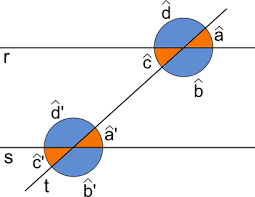
Consider two lines r and s and a transversal t. The interior region is the infinite strip between r and s. The same-side interior angles are the pair lying inside the strip and on the same side of t.
Example with conventional labels:
- On the right of t: (b, a′)
- On the left of t: (c, d′)
If the sum of such a pair is less than 180°, the lines tilt toward each other and will intersect on that side. If the sum is greater than 180°, they tilt apart and intersect on the other side. Exactly 180° means the lines match direction and remain parallel.
Proof by Contradiction for Corresponding Angles
A per assurdo proof that corresponding angles are equal proceeds as follows:
- Assume r ∥ s but a ≠ a′. Without loss of generality, take a′ > a.
- From linear pairs: a + b = 180° and a′ + b′ = 180°, so b′ < b.
- Using vertical angles: c = a and d′ = b′. The left same-side interior pair (c, d′) sums to a + b′ = 180° − (a′ − a) < 180°.
- By the postulate’s same-side interior form, the lines must meet on that side, contradicting r ∥ s.
- Therefore a = a′, and vertical angles give the other congruences.