Linear Approximation
Linear approximation says: near a point, a differentiable function behaves like its tangent line. The gap between the function and the tangent line shrinks faster than the displacement itself.
Prerequisites
- Derivatives, Differentials, and the Chain Rule --- definition of
- The Mean Value Theorem --- needed for the stronger error bound
Notation
- --- a differentiable function
- --- a small displacement from point (also written )
- --- the tangent line at
- --- the remainder (error) of the approximation
Statement
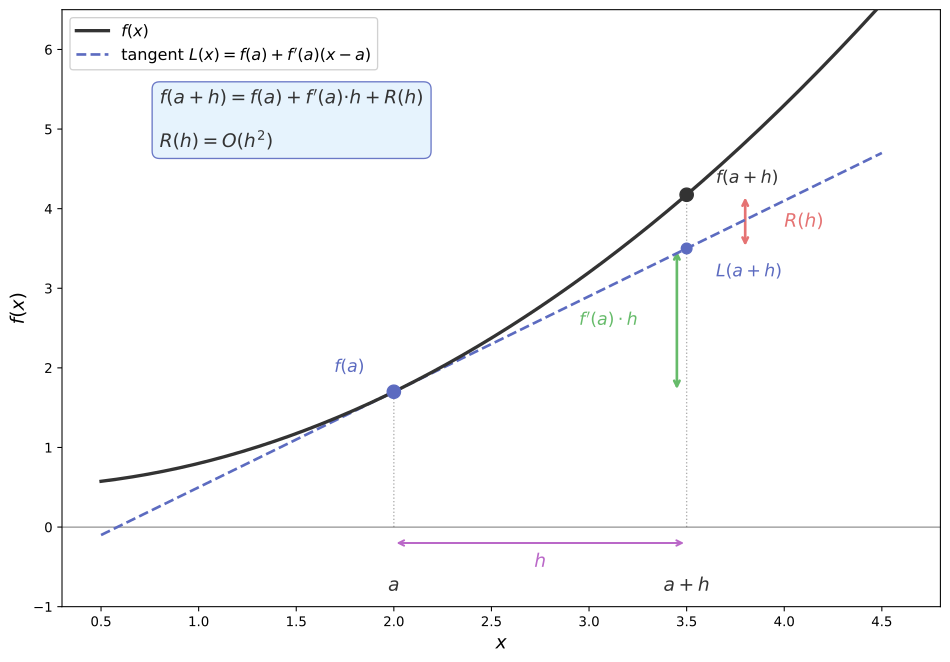
The tangent line at approximates near . The vertical gap (error ) shrinks faster than itself.
Hypothesis: is differentiable at .
Thesis: , where .
The notation means “the error is negligible compared to .” Concretely:
with an error that vanishes faster than .
Proof
Step 1. The derivative is defined as:
Step 2. Define the remainder .
Step 3. Divide by :
Step 4. Take . By definition of derivative (Step 1), the right side .
The stronger error bound:
The proof above only requires differentiability at and gives . With a stronger hypothesis, we get a quantitative bound:
Hypothesis: is twice differentiable on an interval containing and , with on that interval.
Thesis:
Proof
Step 1. By Taylor’s theorem with remainder, there exists between and such that:
Step 2. Take absolute values and bound :
Taylor’s remainder theorem is proved via the Mean Value Theorem applied to a helper function.
Why this matters for the FTC
In the FTC Part 2 proof, Step 3 uses linear approximation on each subinterval:
The error in each term is (where ). Summing terms:
since is constant while .
Without the bound, each error is only , and summing terms that are each does not obviously give something small (uniform convergence arguments are needed). The bound avoids this: .
Logical dependency
The bound uses MVT. The FTC implies MVT as a consequence. This is not circular:
- The FTC proof only needs the weaker result (which uses no MVT) if you handle uniform continuity carefully. The bound is a convenience.
- The logical chain is: definition of derivative MVT error bound FTC Part 2. Each step uses only what came before. “FTC is stronger than MVT” means FTC implies MVT — not that FTC is proved without MVT.
See also
- Derivatives, Differentials, and the Chain Rule --- the differential is linear approximation in differential notation
- The Mean Value Theorem --- needed for the error bound
- The Fundamental Theorem of Calculus --- uses linear approximation in its proof