Regulatory Capital Arbitrage: CDS and Basel II
In one sentence
European banks bought CDS from AAA-rated AIG not to transfer risk but to mechanically reduce regulatory capital — Basel II’s substitution approach replaced the asset’s risk weight with the protection seller’s risk weight, no questions asked about concentration, correlation, or whether the insurer could actually pay.
Prerequisites
- aig-and-the-cds-crisis — the full AIG story, collateral calls, and the bailout
- settlement-and-clearing — CCP clearing and why bilateral CDS was dangerous
- Familiarity with risk-weighted assets (RWA): banks must hold capital proportional to the riskiness of their assets. The minimum is 8% of RWA under Basel II.
Sources
BCBS 128 (Basel II Comprehensive Framework, June 2006). BCBS 189 (Basel III, December 2010). BCBS 283 (Large Exposures Framework, 2014). BCBS d424 (Basel III Final, December 2017). FCIC, The Financial Crisis Inquiry Report (2011), Ch. 11. Acharya, Schnabl & Suarez, “Securitization Without Risk Transfer,” Journal of Financial Economics (2013).
The Substitution Approach
Basel II (BCBS 128, Part 2, Section II.D, paragraphs 189-210) treats CDS as unfunded credit protection. The rule is mechanical:
“Where the guarantee or credit derivative meets the operational requirements […] banks may substitute the risk weight of the protection provider for the risk weight of the counterparty.” — BCBS 128, paragraph 196
That’s it. If a bank holds an asset with a 100% risk weight and buys CDS from a AAA-rated entity (20% risk weight), the bank can replace the asset’s risk weight with 20%. The capital requirement drops from 8% to 1.6% of the exposure.
The rules handle edge cases — partial coverage splits the exposure, maturity mismatches apply a haircut (paragraphs 202-205), currency mismatches apply a supervisory haircut (paragraph 200) — but the core mechanism is a simple lookup table:
Standardised Approach Risk Weights
| External Rating | Corporates | Banks (Option 2) | Securitisation |
|---|---|---|---|
| AAA to AA- | 20% | 20% | 20% |
| A+ to A- | 50% | 50% | 50% |
| BBB+ to BBB- | 100% | 50% | 100% |
| BB+ to BB- | 100% | 100% | 350% |
| Below BB- | 150% | 150% | Deducted |
| Unrated | 100% | 50% | Deducted |
(Source: BCBS 128, paragraphs 53-67 for corporates/banks; 567-613 for securitisation)
AIG held a AAA rating from all three agencies. It was unambiguously eligible as a protection seller under paragraph 195.
Worked Example: The AIG Trade
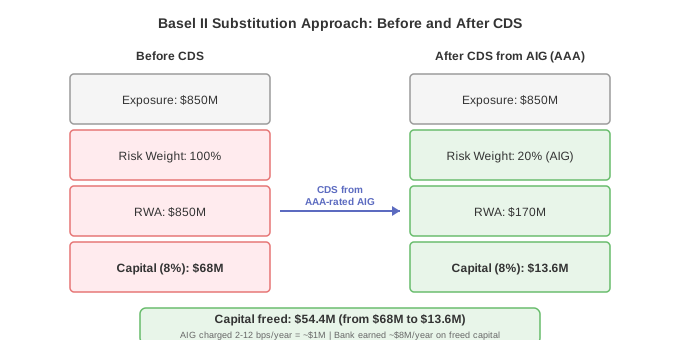 The substitution mechanism: buying CDS from AAA-rated AIG replaced the
asset’s risk weight (100%) with AIG’s risk weight (20%), cutting
required capital from 8% to 1.6% of the protected notional.
The substitution mechanism: buying CDS from AAA-rated AIG replaced the
asset’s risk weight (100%) with AIG’s risk weight (20%), cutting
required capital from 8% to 1.6% of the protected notional.
A European bank holds $1B in mid-market corporate loans (unrated, 100% risk weight under the Standardised Approach). The bank structures a synthetic CDO (Credit Linked Note structure — the loans stay on balance sheet, but credit risk is tranched via CDS):
| Tranche | Attachment | Notional | Buyer |
|---|---|---|---|
| Super-senior | 85-100% | $850M | AIG sells CDS |
| Senior (AAA) | 70-85% | $150M | Institutional investors |
| Mezzanine (A-BBB) | 30-70% | $400M | Hedge funds, CDO managers |
| Equity (first-loss) | 0-30% | $300M | Retained or sold |
Capital on the super-senior portion
| Before CDS | After CDS (AIG, AAA) | |
|---|---|---|
| Exposure | $850M | $850M |
| Risk weight | 100% | 20% |
| RWA | $850M | $170M |
| Capital (8%) | $68M | $13.6M |
| Capital freed | $54.4M |
The ratio: capital dropped from 8% to 1.6% of the protected notional.
The economics
- For the bank: Freed-up capital of $54.4M, redeployed at the bank’s ROE (Return on Equity — the bank’s target return on shareholder capital) target of ~15%, generates ~$8M/year in additional earnings.
- For AIG: CDS premiums on super-senior tranches were 2-12 basis points per annum (FCIC Report, p. 200). On $850M notional, that’s roughly $170K-$1M/year in premium income.
Paying AIG $1M/year for $8M/year in freed earnings was an extraordinary trade. Joseph Cassano (head of AIGFP) reportedly called these “free money” trades — collecting premiums on “risk-free” super-senior tranches that their models said had near-zero probability of loss.
Scale
| Metric | Amount | Source |
|---|---|---|
| AIGFP regulatory capital CDS (2005) | ~$107B | FCIC, p. 200 |
| AIGFP regulatory capital CDS (2007, peak) | ~$379B | FCIC, p. 200 |
| AIGFP multi-sector CDO CDS (separate book) | ~$78B | FCIC, p. 265 |
The $379B regulatory capital book was separate from the $78B multi-sector CDO book that generated the catastrophic losses. The regulatory capital book (corporate loans, prime RMBS, CLOs) performed relatively well through the crisis. It was the multi-sector CDO book — concentrated in subprime RMBS — that destroyed the firm.
Why This Was Allowed: Three Gaps
Gap 1 — No Pillar 1 concentration limit on CRM
Basel II’s Pillar 1 (minimum capital rules) was silent on concentration of credit risk mitigation providers. The substitution approach was purely mechanical: if the protection seller was rated AAA, you got the 20% risk weight. It didn’t matter if 100% of your CRM came from a single counterparty.
Pillar 2 (Supervisory Review Process, paragraphs 720-807) addressed concentration risk as a supervisory concern — banks were expected to assess it in their ICAAP (Internal Capital Adequacy Assessment Process — the bank’s own assessment of how much capital it needs). But Pillar 2 is principles-based, not rules-based. It depended on the supervisor actually challenging the bank’s assessment.
Large exposure limits existed in most jurisdictions (typically 25% of capital to a single counterparty), but these were separate from the Basel capital framework. The Basel Committee’s dedicated Large Exposures Framework (BCBS 283) wasn’t finalized until April 2014.
Gap 2 — No Pillar 1 wrong-way risk provisions
This is the most damning gap. Basel II Pillar 1 did not penalize the correlation between the protection seller and the reference assets.
Wrong-way risk (WWR — the risk that exposure to a counterparty increases precisely when that counterparty’s credit quality deteriorates) was not addressed in the Pillar 1 CRM rules. The substitution approach was a mechanical lookup: AAA = 20%. No adjustment for the joint probability structure. No penalty for the protection seller being a systemic financial institution whose creditworthiness was correlated with the same factors that would cause the protected assets to default.
The systems analogy
Wrong-way risk in CDS is the same problem as correlated failures in redundancy schemes. If your backup node shares a failure mode with the primary (same datacenter, same power supply, same network switch), your redundancy is illusory. AIG was the “backup” for hundreds of billions in credit risk, but its failure mode (systemic financial crisis) was exactly the scenario in which the protection was needed.
The FSB/Joint Forum published guidance in 2005 (Credit Risk Transfer) flagging counterparty concentration and correlation concerns, but this was guidance, not binding Pillar 1 rules.
Gap 3 — No CVA capital charge
Under Basel II, if AIG’s CDS was performing (no credit event triggered), there was zero ongoing capital charge for AIG’s deteriorating creditworthiness. As AIG’s spreads widened through 2007-2008, the mark-to-market value of the CDS protection declined — but this generated no additional capital requirement.
Post-Crisis Reforms
The crisis exposed these gaps as first-order regulatory failures. The response came in several overlapping waves:
| Reform | What It Does | AIG Loophole Addressed |
|---|---|---|
| CVA capital charge (BCBS 189, 2010; revised BCBS d507, 2020) | Capital against mark-to-market risk of derivative counterparties | As AIG’s spreads widen, capital charge rises automatically — an automatic brake |
| Wrong-way risk rules (BCBS 189, Annex 4, paragraphs 56-58) | Explicit identification and capital penalty for correlated counterparty-exposure pairs | Specific WWR (protection seller correlated with reference entity) gets punitive EAD treatment |
| Large Exposures Framework (BCBS 283, 2014) | 25% of Tier 1 capital to any single counterparty (15% for G-SIB to G-SIB) | Caps how much CRM a bank can get from one entity |
| Output floor (BCBS d424, 2017) | IRB banks must hold >=72.5% of Standardised Approach capital | Limits model-based capital optimization |
| Central clearing mandates (Dodd-Frank Title VII; EMIR) | Standardized CDS cleared through CCPs | Eliminates bilateral counterparty concentration (creates CCP concentration — a different problem) |
| Revised securitisation framework (BCBS 303, 2014) | Higher capital charges for securitisation exposures | Makes the underlying trade economics less attractive |
The AIG trade is now effectively impossible to replicate at scale under the current framework. Multiple overlapping mechanisms would block it: the CVA charge makes it capital-expensive even while performing, the WWR rules penalize the correlation, and the large exposures framework caps concentration.
Was It Risk Transfer or Capital Optimization?
The FCIC report is unambiguous:
“AIGFP’s credit default swap business was aimed at regulatory capital relief for European banks. The banks were not seeking to transfer risk to AIG; they were seeking to reduce the capital they were required to hold against assets they considered safe.” — FCIC Final Report, Chapter 11
The evidence:
- Premiums were too low for genuine risk transfer. At 2-12 bps/year on super-senior tranches, the pricing reflected near-certainty that AIG would never pay out. Genuine risk transfer would command higher premiums.
- AIG posted no collateral initially. A bank genuinely seeking risk transfer would demand collateral to ensure the seller could perform.
- The timing tracks Basel II implementation. AIGFP’s regulatory capital book exploded from $2B (2003) to $107B (2005) to $379B (2007), exactly tracking the phased implementation of Basel II in European jurisdictions (CRD I effective January 2007).
- AIGFP’s marketing materials explicitly framed these as “regulatory capital relief” solutions, not risk management products.
Acharya, Schnabl & Suarez (2013) document this pattern systematically: banks structured transactions to achieve regulatory capital relief while retaining the economic risk — either through explicit guarantees, liquidity puts, or by purchasing CDS from entities whose default was correlated with the underlying risk.
The Irony
The regulatory capital CDS book ($379B) actually performed fine through the crisis. The underlying assets — corporate loans, prime RMBS, CLOs — were relatively safe. The banks’ assessment that they didn’t need the protection economically was correct.
The catastrophic losses came from the other book: $78B in multi-sector CDO CDS concentrated in subprime RMBS. If the regulatory capital book had been AIGFP’s only business, AIG wouldn’t have collapsed.
The deepest irony: the CDS protection was purchased to satisfy a regulation designed to make banks safer. Instead, it made the entire system more fragile by creating a single point of failure at AIG. The protection existed to satisfy a rule, not to manage a risk — and the rule didn’t check whether the protection was real.
Questions to sit with:
-
The substitution approach assumes that buying CDS transfers credit risk. But if the protection seller and the reference portfolio share a common failure mode (systemic crisis), the risk isn’t transferred — it’s concealed. Basel II’s Pillar 1 couldn’t distinguish between genuine risk transfer and risk concealment. Is this a fixable modelling problem (add a correlation adjustment to the substitution formula) or a fundamental limit of rules-based regulation (any mechanical rule can be gamed)?
-
The $379B regulatory capital book performed well, proving the banks were right that the underlying assets were safe. Does this make the trade rational from the banks’ perspective — even in hindsight? Or does the systemic concentration risk at AIG mean the trade was reckless regardless of the individual bank’s outcome? When does an individually rational trade become collectively irrational?
-
Post-crisis reforms address the AIG loophole through six overlapping mechanisms (CVA, WWR, large exposures, output floor, clearing, securitisation framework). Is this defense-in-depth, or is it regulatory complexity that creates new blind spots? Basel II was simple and had a fatal gap. Basel III is complex — does complexity guarantee it has no fatal gaps, or does it just make them harder to find?
See also
- aig-and-the-cds-crisis — the full AIG crisis narrative, including the multi-sector CDO book that actually generated losses
- Binomial Expansion Technique — the model that told AIGFP super-senior losses were negligible
- settlement-and-clearing — CCP clearing, the post-crisis mandate, and why bilateral CDS was dangerous
- Credit Risk — the Basel capital logic and the Vasicek single-factor model
Sources
- BCBS 128, “International Convergence of Capital Measurement and Capital Standards: A Revised Framework — Comprehensive Version,” June 2006.
- BCBS 189, “Basel III: A global regulatory framework for more resilient banks and banking systems,” December 2010.
- BCBS 283, “Supervisory framework for measuring and controlling large exposures,” April 2014.
- BCBS 303, “Revisions to the securitisation framework,” December 2014.
- BCBS d424, “Basel III: Finalising post-crisis reforms,” December 2017.
- BCBS d507, “Targeted revisions to the credit valuation adjustment risk framework,” July 2020.
- FCIC, The Financial Crisis Inquiry Report (2011), Chapter 11.
- Acharya, V., Schnabl, P., and Suarez, G. (2013). “Securitization Without Risk Transfer.” Journal of Financial Economics.
- FSB/Joint Forum, “Credit Risk Transfer,” March 2005.