Options Basics: Calls, Puts, and Straddles
Why this note exists
Options are the fundamental building block of derivatives pricing. Every structured product, every hedging strategy, and every volatility trade reduces to combinations of calls and puts. This note builds the concept from scratch.
Prerequisites
None. This starts from zero. If you already know what calls and puts are, skip to the straddle section.
What Is an Option?
An option is a contract that gives you the right, but not the obligation, to buy or sell an asset at a specified price on (or before) a specified date.
The key terms:
- Underlying — the asset the option is written on (e.g., a stock, ETH, an index).
- Strike price () — the price at which you can buy or sell.
- Expiration () — the date the option expires.
- Premium — the price you pay upfront to acquire the option.
There are two basic types:
| Type | Right | You buy this when you think… |
|---|---|---|
| Call | Buy the underlying at | The price will go up |
| Put | Sell the underlying at | The price will go down |
Payoff Diagrams: The Hockey Sticks
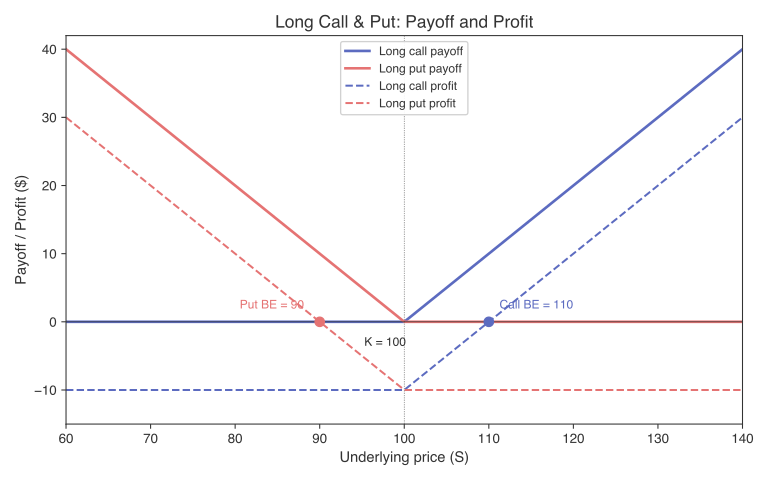 Call and put payoff diagrams at expiration — the characteristic hockey-stick shapes.
At expiration, the underlying’s price is . The payoff — the value of the option at that moment, ignoring what you paid for it — depends on whether the price moved in your favour:
The captures the key idea: if the price moved against you, you simply don’t exercise — your loss is capped at the premium you already paid.
Example: You buy a call on ETH with strike K = \2{,}000$.
- If ETH is at $2,500 at expiration: payoff = $2,500 - $2,000 = $500.
- If ETH is at $1,800 at expiration: payoff = = $0. You just don’t exercise.
When plotted, the call payoff is flat at zero below the strike and rises linearly above it. The put is the mirror image. These are the famous “hockey stick” shapes — explore them interactively in the companion notebook.
See it
Open notebook and drag the strike and premium sliders. Watch the hockey sticks shift. The profit lines (dashed) show that you need the price to move past to make money.
Profit is payoff minus the premium you paid. A call buyer needs the price to rise above premium to break even. A put buyer needs it to fall below premium.
Buying vs Selling Options
Every option trade has two sides:
| Buyer (long) | Seller (short, “writer”) | |
|---|---|---|
| Pays | Premium upfront | Receives premium upfront |
| Risk | Limited to premium paid | Potentially unlimited (calls) or large (puts) |
| Wants | Big price moves | Price to stay near strike |
| Payoff shape | Hockey stick (upside) | Inverted hockey stick (downside) |
The seller collects the premium and hopes the option expires worthless (price stays near the strike). The seller’s payoff is the negative of the buyer’s — it’s a zero-sum game.
This is the first hint of why option sellers exist. Collecting premium in exchange for bearing risk — with the hope that the risk doesn’t materialize — is one of the oldest strategies in finance.
The Straddle: Betting on Movement
A straddle combines a call and a put at the same strike and same expiration :
At any price, exactly one leg is in-the-money (ITM — worth exercising) and the other is out-of-the-money (OTM — worthless). The two terms sum to the absolute distance from the strike. The straddle profits from any large move — direction doesn’t matter.
Long Straddle (buying)
- Pays two premiums (expensive).
- Profits when the price moves far from in either direction.
- Loses when the price stays near .
- Bet: “volatility will be high.”
Short Straddle (selling)
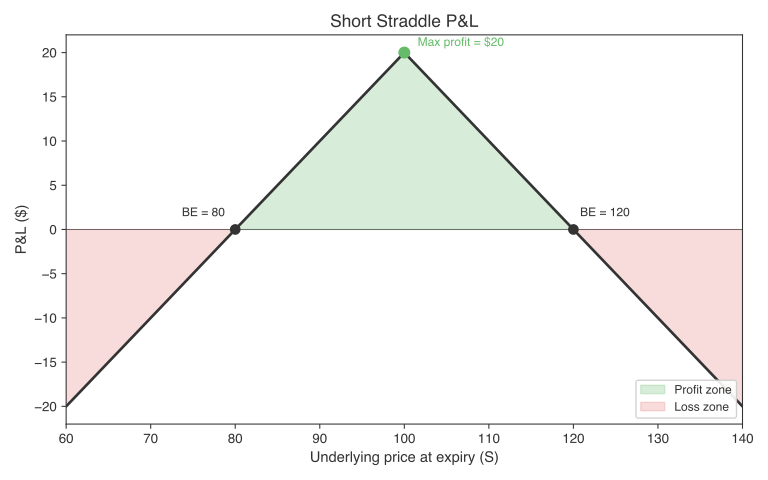 Short straddle P&L: maximum profit at the strike, losses grow as price moves away.
- Collects two premiums.
- Profits when the price stays near .
- Loses when the price moves far from .
- Bet: “volatility will be low.”
See it
Open notebook Section 2 and play with the straddle strike and premium. The short straddle (red line) shows the inverted-V shape — maximum profit at the strike, losses growing in both directions. The green dashed lines are break-even points.
The short straddle is one of the most common option-selling strategies. Its risk profile — collecting premium while exposed to large moves — appears throughout finance. The Greeks note explains the mathematics of this exposure through delta and gamma.
Companion notebook: notebook — interactive payoff diagrams for calls, puts, and straddles with adjustable strike and premium.
Questions to sit with:
- A short straddle seller profits when the price stays near the strike and loses when it moves far away. But the straddle seller chose a specific strike at trade time. What happens to the risk profile if the underlying drifts slowly away over weeks — is the position still effectively “at the money,” or has it become something different?
- An earnings announcement is scheduled in 3 days. Implied vol is 45%, but historical vol has been 25%. Should you buy or sell a straddle? What are you betting on?
- A short straddle seller can delta-hedge to neutralize directional risk, isolating the pure volatility bet. What does this delta-hedging cost, and when does it fail?
See also
- the-greeks — delta, gamma, and vega
- volatility — realized vs implied vol
- black-scholes — the standard option pricing model