The LP as Short Volatility
Why this note exists
Three separate notes build pieces of this picture: volatility defines realized and implied vol, the-greeks shows the LP is short gamma, and lp-profitability gives the break-even formula. This note ties the threads together into a single statement: an LP is selling volatility, and the fee structure defines the LP’s implied vol.
Prerequisites
- volatility — what realized and implied volatility are
- options-basics and the-greeks — straddles and gamma
- impermanent-loss — the IL formula ()
- lp-profitability — the break-even condition
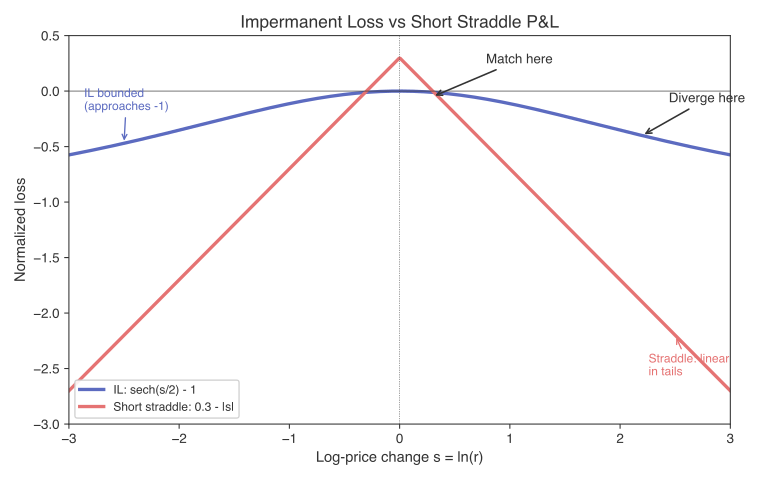 IL loss curve overlaid with short straddle P&L — the shapes match near the strike, diverge in the tails.
The IL–Volatility Connection
The Taylor expansion of IL for small log-price changes :
Over a period, averages to (the variance of log-returns). So the expected daily IL for an LP is approximately:
IL grows with the square of volatility. Double the vol → 4× the loss. This quadratic dependence is the hallmark of a short gamma position (see [[the-greeks#Gamma (): Sensitivity of Delta to Price|the gamma section]]).
Break-Even Vol: The LP’s Implied Volatility
The break-even formula sets daily fee income equal to daily IL:
where is the fee rate, is daily volume, and is total pool liquidity (TVL).
This is the LP’s implied volatility. Just as an option seller profits when realized vol stays below the implied vol embedded in the premium, an LP profits when the token pair’s realized vol stays below .
| Options market | LP position |
|---|---|
| Implied vol () | Break-even vol () |
| Realized vol () | Actual price volatility of the token pair |
| Seller profits when | LP profits when |
The volatility risk premium (VRP) — the empirical fact that implied vol tends to exceed realized vol on average — explains why many LP positions are modestly profitable in calm markets. LPs are collecting the DeFi analogue of the VRP.
Short Straddle vs LP: Full Comparison
| Concept | Short straddle | LP position |
|---|---|---|
| What you collect | Option premiums | Trading fees |
| What you lose to | when price moves | Impermanent loss when price moves |
| Payoff symmetry | Symmetric around strike | Symmetric in log-price around deposit price |
| Quadratic loss | (log-price) | |
| Break-even | Realized vol < implied vol of premium | Realized vol < from fees |
| Risk profile | Short gamma, short vol | Short gamma, short vol |
| Tail behaviour | Loss grows linearly in tails | Loss bounded at -100% (sech-shaped) |
Where the Analogy Breaks: The Tails
Near the strike (small price moves), the short straddle and the LP position behave identically — both lose proportionally to .
In the tails (large price moves), they diverge:
- A short straddle’s loss grows linearly without bound. The call or put pays dollar-for-dollar as the price moves further from the strike.
- An LP’s loss is bounded by the formula (see IL properties). The maximum possible loss is 100% of the position — the LP can never owe more than they deposited.
This means the straddle analogy overstates LP risk in the tails. For tokens with extreme moves (memecoins going to zero or 100×), the LP’s actual loss is less severe than a literal short straddle would predict.
Questions to sit with:
- If is the LP’s implied vol, can you construct a trading strategy that exploits mispricings between the LP’s implied vol and options implied vol on the same asset?
- The VRP says implied > realized on average. But averages include calm periods subsidizing rare crashes. Is the LP’s fee income high enough to survive the tails — especially for memecoins with 200–500% vol?
- An options straddle has a fixed expiry. An LP position does not. How does the “rolling” nature of LP exposure change the vol comparison?
See also
- volatility — realized vs implied vol, measurement methods
- the-greeks — delta, gamma, and the formal LP-gamma connection
- impermanent-loss — the IL formula and its quadratic / sech structure
- lp-profitability — the break-even formula and profitability analysis
- options-basics — calls, puts, and straddles from scratch