The Mean Value Theorem
The Mean Value Theorem (MVT) says: if a function is differentiable on an interval, then somewhere in that interval its instantaneous rate of change equals its average rate of change.
Prerequisites
- Derivatives, Differentials, and the Chain Rule --- what means
- Continuity on closed intervals, differentiability on open intervals
Notation
- --- a function continuous on and differentiable on
- --- the derivative (instantaneous rate of change) at point
- --- the average rate of change (slope of the secant line from to )
Statement
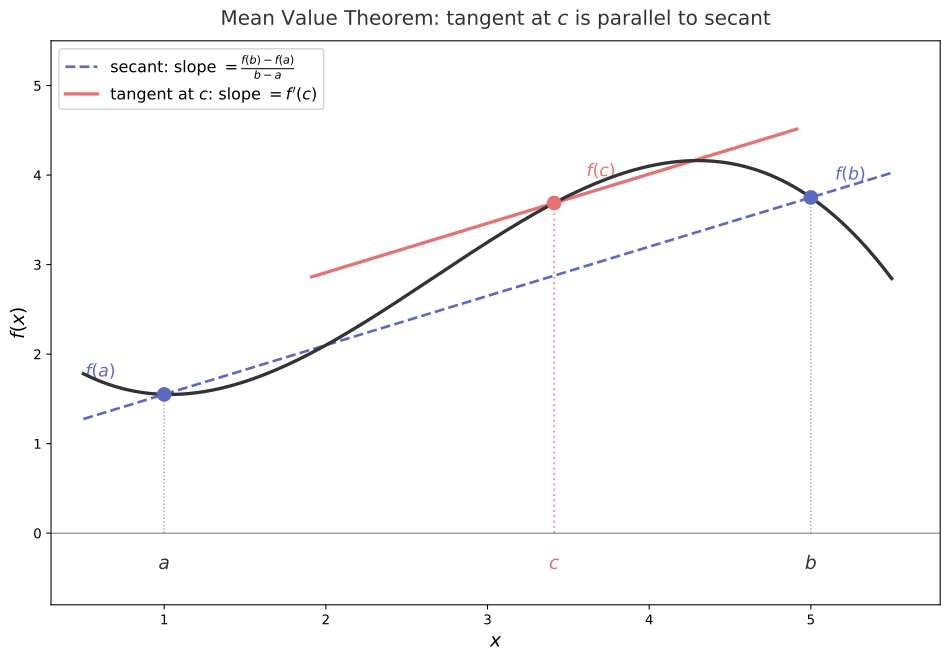
The dashed blue line is the secant (average slope over ). The red line is the tangent at . MVT guarantees at least one where these are parallel --- but not where.
Hypothesis: is continuous on and differentiable on .
Thesis: There exists such that
Equivalently, multiplying both sides by :
Proof
The proof constructs a helper function that turns the problem into an application of Rolle’s theorem (a special case of MVT where ).
Step 1. Define , where is the secant line from to .
Step 2. Observe that and (both endpoints lie on the secant line, so there).
Step 3. is continuous on and differentiable on (since is, and is a polynomial). Apply Rolle’s theorem: there exists with .
Step 4. Compute .
Step 5. Set and solve.
Rolle’s theorem (the special case)
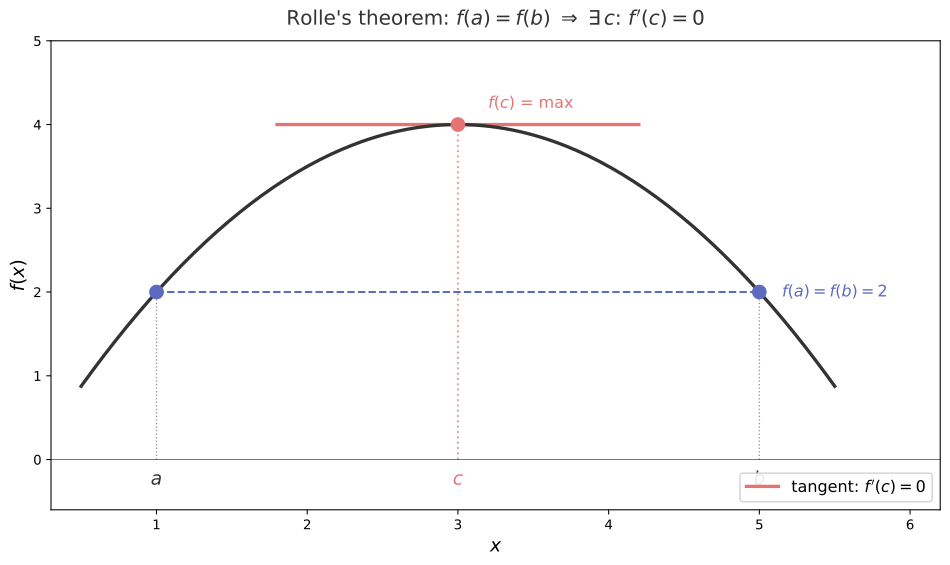
: the function starts and ends at the same height. Somewhere in between it must turn around — that turning point has a horizontal tangent ().
Hypothesis: continuous on , differentiable on , and .
Thesis: There exists with .
Geometric intuition: if you start and end at the same height, you either stayed flat the whole time (constant function, derivative is zero everywhere) or you went up and came back down (or down and back up). At the highest (or lowest) point, the tangent must be horizontal.
Proof
Step 1. is continuous on , so by the extreme value theorem (Weierstrass), attains a maximum and minimum somewhere on .
Step 2. If , then is constant, and for all . Done.
Step 3. If , at least one of them differs from . That extremum occurs at some interior point (not at an endpoint, since both endpoints have the same value).
Step 4. At an interior extremum of a differentiable function, the derivative is zero (Fermat’s theorem: if is a local max/min and exists, then ).
Why MVT reduces to Rolle
The MVT proof (above) constructs where is the secant line. This satisfies — exactly Rolle’s hypothesis. So the entire MVT is just “subtract the secant line, apply Rolle’s.”
Limitations
- Existential, not constructive. MVT says exists but gives no formula for it. You cannot compute without additional information about .
- Requires differentiability on the entire open interval. If has even one point where does not exist (e.g., at ), MVT does not apply.
- Weaker than the Fundamental Theorem of Calculus. See Connection to the Mean Value Theorem --- FTC gives a complete computation (), while MVT only guarantees one point where the derivative hits the average.