The Fundamental Theorem of Calculus
The Fundamental Theorem of Calculus (FTC) says that differentiation and integration are inverse operations. It has two parts --- one proves this from each direction.
Prerequisites
- Derivatives, Differentials, and the Chain Rule --- what means
- Riemann sums --- approximating the area under a curve by partitioning into strips and summing rectangle areas ; the integral is the limit as
Notation
- --- the function whose area we want to compute (the integrand)
- --- an antiderivative of , meaning . Antiderivatives are not unique: if is one, then is another for any constant . This doesn’t matter for the FTC because the constant cancels in .
- --- the “area so far” function (area under from to )
- --- a small increment in ; becomes in the limit
Intuition
Two insights, one per direction:
-
Area grows at rate = height. If you sweep a vertical line from left to right under a curve, the rate at which area accumulates at position is exactly --- the height of the curve there. (FTC Part 1)
-
Total change = sum of tiny changes. If you chop into many tiny differences, each difference is approximately a rectangle of area , and the whole thing telescopes so only the endpoints survive. (FTC Part 2)
FTC Part 2: the telescoping direction
Hypothesis: is continuous on , and is an antiderivative of (i.e., for all ).
Thesis:
You start with a function that you already know satisfies . The theorem says: then you can evaluate the integral by just plugging and into . Without this, computing means taking the limit of Riemann sums. With it, you recognize satisfies , so the answer is .
Proof
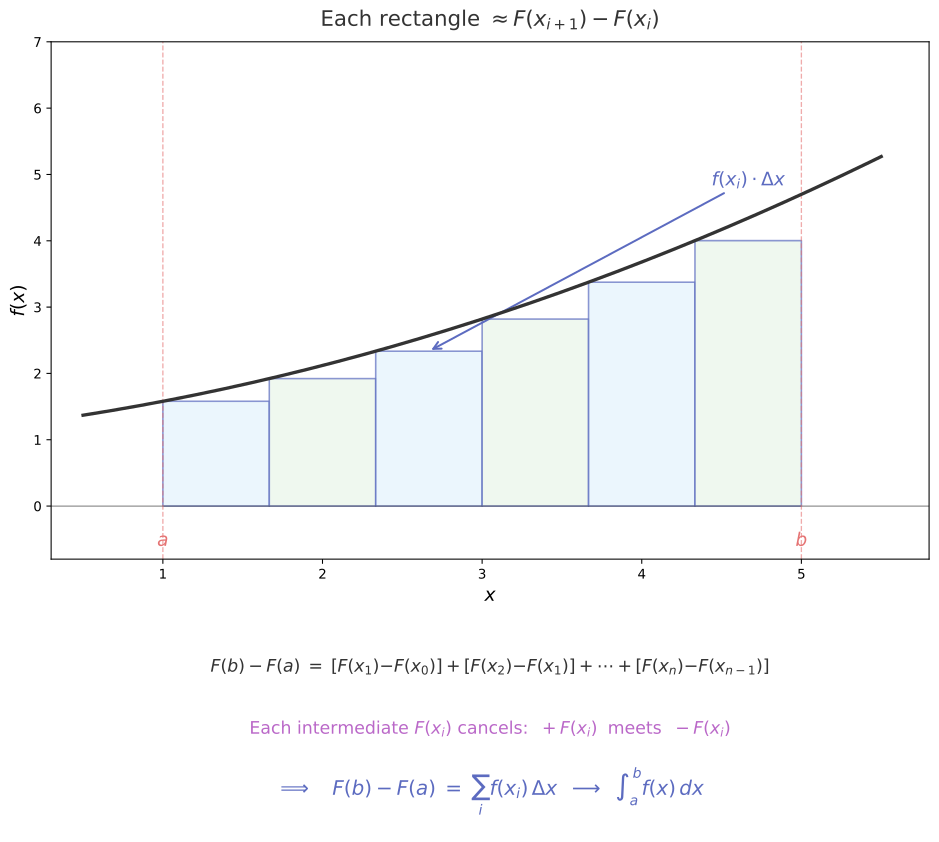
splits into tiny differences . Intermediate values cancel (telescope), leaving only endpoints.
Step 1. Partition into subintervals of width .
Step 2. Write as a telescoping sum (pure arithmetic --- each intermediate cancels).
Step 3. Approximate each term by linear approximation.
Step 4. Substitute the hypothesis .
Step 5. Combine Steps 2—4.
Step 6. Take . The left side is exact (telescope holds for any ). The right side by definition of Riemann integral. The approximation error per term is ; summing terms gives .
FTC Part 1: the area-accumulation direction
Hypothesis: is continuous on .
Construction: Define (area under from to ).
Thesis: for all . That is, is an antiderivative of .
Why this is non-trivial
looks like “the derivative undoes the integral” --- a tautology. It isn’t, because and are defined by different limiting processes:
- is a limit of Riemann sums (partition , sum rectangles, take ).
- is a limit of difference quotients ().
The theorem says these two nested limits compose cleanly: build via one infinite process, differentiate via another, get back . This requires to be continuous --- if has a jump at , then has a corner at and does not exist.
Physical version: Water flows into a tank at rate litres/second. Total water is . The rate of change of total water is . Physically obvious --- but the theorem proves that the Riemann-sum definition of and the difference-quotient definition of actually produce this result.
Proof
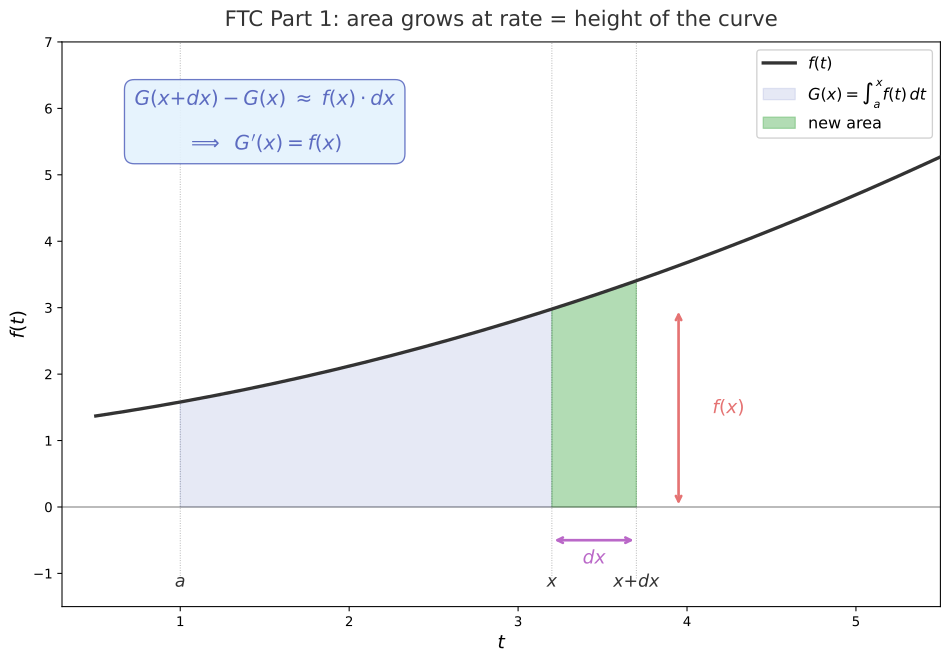
Nudging by adds a thin strip of width and height .
Step 1. Write using the definition of .
Step 2. Since is continuous (hypothesis), on . Approximate the integral.
Step 3. Divide by .
Step 4. Bound the error. Continuity at gives: for any , there exists such that whenever .
Step 5. Take . Since was arbitrary, the limit exists.
How the two parts connect
| FTC Part 1 | FTC Part 2 | |
|---|---|---|
| Says | ||
| Direction | Area antiderivative | Antiderivative area |
| Answers | ”Why are they related?" | "How do I compute it?” |
| Key idea | Area grows at rate = height | Total change = sum of tiny changes |
The logical dependency: Part 2 assumes an antiderivative exists and shows how to use it. But who says even has an antiderivative? Part 1 answers this: it constructs one explicitly --- namely --- and proves . So Part 1 guarantees existence, Part 2 gives the computation.
This also explains why “any antiderivative works” in Part 2: if and are both antiderivatives of , they differ by a constant (), and the constant cancels in .
Worked example
Let . We want .
Using FTC Part 2: An antiderivative is (since ). Therefore:
Verifying geometrically: The region under from to is a trapezoid with parallel sides and , and width :
Verifying FTC Part 1: Define . Then . The area function’s derivative is indeed the original function.
Connection to the Mean Value Theorem
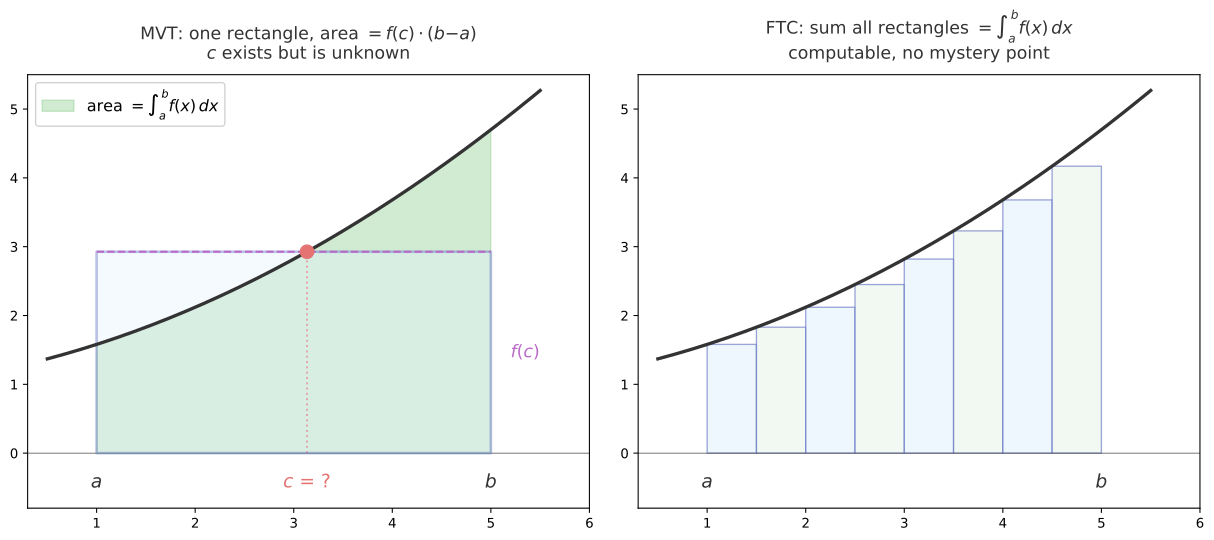
Left: green = actual area under . Blue rectangle at height has the same area, but you don’t know . Right: sum many thin rectangles to compute the same area without needing any special point.
Both theorems express in terms of :
| Statement | What you get | |
|---|---|---|
| MVT | for some | One rectangle, unknown |
| FTC | All rectangles, computable |
MVT is existential: it guarantees exists but doesn’t tell you where. FTC is constructive: it gives the answer as a computation. FTC implies MVT (apply the intermediate value theorem to the integral), but not vice versa.
Questions to sit with
-
What happens at discontinuities? If has a jump at , then is still continuous (area doesn’t jump) but has a corner at --- continuous but not differentiable. Does the integral of still exist? (Yes --- integrability and differentiability of the area function are separate questions. FTC Part 1 fails at , but the integral over is still well-defined.)
-
Why does Part 2 feel more useful than Part 1? Part 2 gives you a computation shortcut (evaluate at endpoints). Part 1 gives you an existence guarantee (continuous antiderivative exists). In practice you use Part 2 constantly. When would you actually need Part 1? (Answer: when you don’t have a formula for but need to reason about as a function --- e.g., proving that solutions to differential equations exist.)
-
The telescoping argument works for any differentiable . We never used anything special about being an antiderivative of a nice function. So why can’t we apply FTC to any random differentiable function? (We can --- the only requirement is that must be integrable. Most “well-behaved” functions satisfy this, but pathological counterexamples exist.)
The Italian variant
At Politecnico, the FTC is often taught as a single theorem combining both statements: if is continuous on and is any antiderivative of , then . The Anglo-American tradition (MIT 18.01, Stewart, Spivak) splits this into two numbered parts to emphasize the two different conceptual directions. The mathematical content is the same.
See also
- Derivatives, Differentials, and the Chain Rule
- Linear Approximation --- the key tool in the Part 2 proof (Step 3)
- The Mean Value Theorem