The Greeks: Delta, Gamma, and Vega
Why this note exists
The Greeks are how traders quantify and manage the risks of an options portfolio. If you hold or sell options, you need to know how much you’ll gain or lose when the price moves (delta), when it moves a lot (gamma), when time passes (theta), or when volatility changes (vega). This note defines each Greek and shows how they interact.
Prerequisites
options-basics — what calls, puts, and straddles are.
Notation
- — current price of the underlying
- — strike price
- — option value
- (Delta) — rate of change of option value with respect to price
- (Gamma) — rate of change of Delta with respect to price
- — volatility
Training-data note
This note was written from Claude’s training data (standard options textbook material — Hull Ch. 19). Cross-check formulas against your preferred derivatives textbook.
The Greeks: How Options Respond to Change
The Greeks measure how an option’s price changes when market conditions change. They are partial derivatives of the option price with respect to different variables.
Delta (): Sensitivity to Price
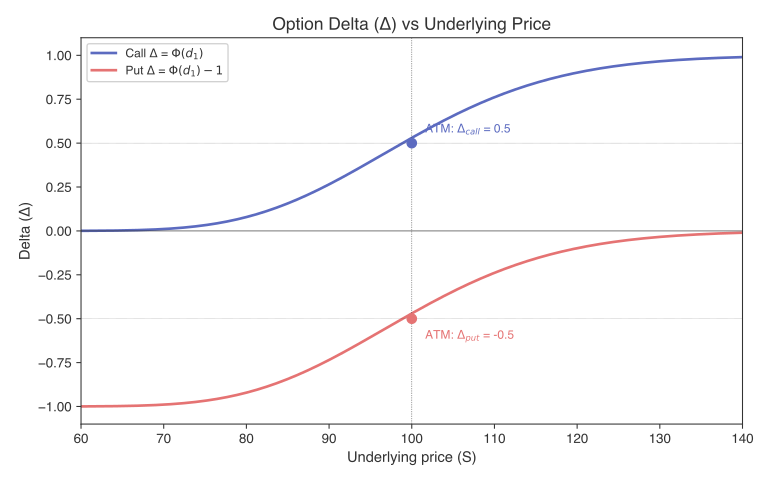 Delta as a function of the underlying price — the S-curve from 0 to 1 for a call.
Delta answers: “if the underlying moves $1, how much does my option’s value change?” It is the first derivative of the option value with respect to the underlying price:
| Option | Delta range | Intuition |
|---|---|---|
| Long call | 0 to +1 | Option gains value when price rises |
| Long put | -1 to 0 | Option gains value when price falls |
| Short call | 0 to -1 | Opposite of long call |
| Short put | 0 to +1 | Opposite of long put |
An at-the-money (ATM) call — where the current price equals the strike () — has : a $1 move in the underlying changes the option value by about $0.50.
A deep in-the-money (ITM) call () has : it behaves almost like holding the underlying directly.
A deep out-of-the-money (OTM) call () has : it barely responds to price changes.
Gamma (): Sensitivity of Delta to Price
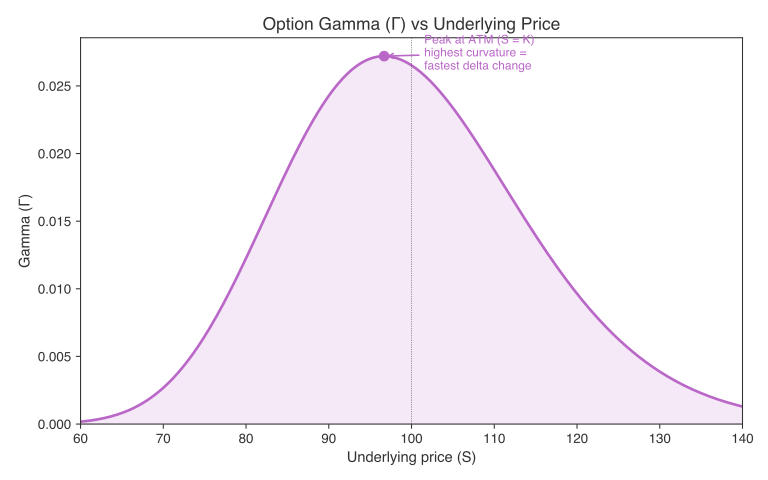 Gamma peaks at-the-money — this is where the option’s curvature is greatest.
Gamma answers: “how fast does delta itself change as the price moves?” It is the second derivative of the option value — or equivalently, the rate of change of delta with respect to the underlying price:
Gamma is the curvature of the option’s value with respect to price. It is highest for ATM options (where delta is changing fastest) and low for deep ITM or deep OTM options (where delta is nearly constant).
Why gamma matters for P&L:
If you are long gamma (bought options), your position automatically adjusts in your favour: as the price rises, your delta increases (you’re effectively buying more); as it falls, your delta decreases (you’re effectively selling). You profit from moves in either direction. This is the long straddle effect.
If you are short gamma (sold options), the opposite: as the price moves away from the strike, you lose at an accelerating rate. Your P&L from a price move of size is approximately:
For a short gamma position, , so the P&L is negative and quadratic in the price move. Double the price move → 4x the loss.
Worked example: short straddle gamma loss
Suppose you sold an ATM straddle on a stock at S = \100\Gamma = -0.05\Delta S = $10$.
Double the move to \Delta S = \20$:
The loss quadrupled — this is the quadratic nature of gamma exposure. Short gamma positions bleed faster as moves get larger, which is why straddle sellers care intensely about realized volatility.
Other Greeks (for completeness)
| Greek | Symbol | Measures sensitivity to | One-line intuition |
|---|---|---|---|
| Theta () | Passage of time | Options lose value as expiry approaches (“time decay”) | |
| Vega () | Implied volatility | Higher vol = more expensive options | |
| Rho () | Interest rate | Usually small; matters for long-dated options |
For option sellers, delta and gamma drive the immediate P&L from price moves. Theta works in their favor (time decay erodes the option’s value, benefiting the seller). Vega matters because a spike in implied vol increases the mark-to-market value of options the seller is short.
Putting It Together: Managing a Short Straddle
A short straddle seller has a distinctive Greek profile:
| Greek | Exposure | What it means |
|---|---|---|
| Delta | Near zero at inception (ATM) | No directional bias initially |
| Gamma | Negative | Losses accelerate as price moves away from strike |
| Theta | Positive | Time decay earns money every day |
| Vega | Negative | A vol spike increases the value of the options you’re short |
The seller’s core bet: theta income exceeds gamma losses. In calm markets (realized vol < implied vol), theta wins — the options decay toward zero and the seller keeps the premium. In volatile markets, gamma overwhelms theta and the position bleeds.
Delta-hedging neutralizes directional risk. The seller continuously buys or sells the underlying to keep net delta near zero, isolating the pure volatility bet. The cost of delta-hedging over the option’s life converges to the realized variance — this is the fundamental insight behind Black-Scholes hedging theory. If realized vol comes in below the implied vol embedded in the premium, the hedged seller profits.
Companion notebook: notebook — interactive delta and gamma curves; short straddle P&L under different vol scenarios.
Questions to sit with:
- You sold a straddle on AAPL at strike $180. AAPL is now at $200. Is your delta positive or negative? How would you delta-hedge?
- A trader sells straddles and delta-hedges daily. In a month where realized vol matches implied vol exactly, does the trader make or lose money? Why?
- Gamma is highest ATM and decreases as the option moves ITM or OTM. What happens to gamma as expiration approaches — does it increase or decrease for ATM options?
See also
- options-basics — calls, puts, and straddles from scratch
- volatility — realized vs implied volatility
- black-scholes — the pricing model that connects Greeks to hedging costs