Binomial Expansion Technique (BET)
In one sentence
BET collapses a pool of correlated credits into an equivalent number of independent, identical credits, then uses the binomial distribution to compute the probability of losses reaching each CDO tranche. The technique is elegant, tractable, and — for multi-sector CDOs backed by subprime RMBS — catastrophically wrong.
Prerequisites
- Structured Products — CDO tranching, attachment points, credit enhancement
- aig-and-the-cds-crisis — how AIGFP used a BET-derived model to conclude super-senior losses were negligible
- Basic probability — binomial distribution, expected value, standard deviation
Intuition
Imagine you hold a CDO backed by 120 corporate loans. You want to know: “What is the probability that losses wipe out the bottom 15% of the pool and start eating into my super-senior tranche?”
The honest answer requires modelling how defaults are correlated — if one auto manufacturer defaults, are other manufacturers more likely to follow? In 1996, nobody had reliable pairwise correlation estimates for 120 credits, and Monte Carlo simulation was computationally expensive.
BET’s shortcut: don’t model the correlations explicitly. Instead, ask: “How many truly independent bets does this portfolio represent?” That number is the diversity score. If 120 correlated loans behave like 40 independent loans, set the diversity score to 40 and use the binomial distribution — which has a closed-form formula — to compute loss probabilities.
The key insight that made this fail: the diversity score is computed from industry labels, not from actual statistical dependence. A pool of RMBS tranches drawn from “residential mortgages,” “home equity,” and “consumer ABS” looks diversified by label. In reality, they are all bets on U.S. housing prices — effectively one bet, not forty.
Notation
- — diversity score (equivalent number of independent credits)
- — weighted-average default probability of the pool
- — weighted-average recovery rate
- — number of defaults
- , — attachment and detachment points of a tranche (as fractions of total pool par)
Origin
Arturo Cifuentes and George O’Connor introduced BET in a Moody’s Special Report, The Binomial Expansion Method Applied to CBO/CLO Analysis (December 1996). Cifuentes was a managing director at Moody’s Structured Finance group.
The problem they solved: how do you rate tranches of a CDO when the collateral pool has 100+ credits with heterogeneous default probabilities, different par amounts, and unknown pairwise correlations? Full Monte Carlo with a rich correlation structure was computationally expensive (this is 1996) and required correlation inputs nobody had reliable estimates for.
Their answer — elegant and fatally simplifying — was: don’t model correlations explicitly. Collapse the entire portfolio into an equivalent number of independent, identical credits.
The Diversity Score
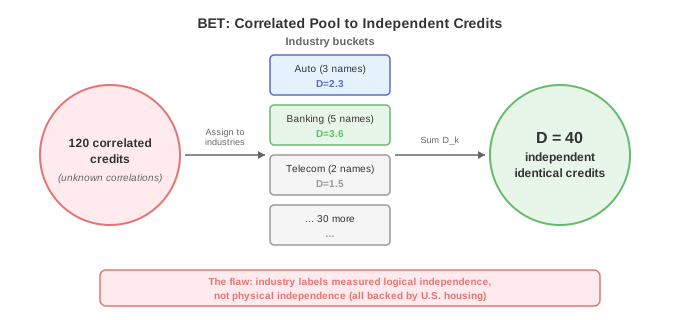 BET maps a correlated pool to an equivalent number of independent credits
via industry bucketing. The diversity score is the sum of
per-industry diversity contributions.
BET maps a correlated pool to an equivalent number of independent credits
via industry bucketing. The diversity score is the sum of
per-industry diversity contributions.
The diversity score answers: “How many truly independent bets does this portfolio represent?” The computation has five steps:
Step 1 — Industry bucketing. Each obligor is assigned to one of Moody’s ~33 industry classification groups. The key assumption: credits within the same industry are perfectly correlated; credits in different industries are independent. This is the blunt instrument at the heart of the model.
Step 2 — Issuer-level aggregation. For each issuer , compute the total par amount . Compute the average par across all issuers:
Step 3 — Equivalent unit score per issuer. Each issuer contributes:
This caps any single issuer’s contribution at 1.0, penalizing concentration.
Step 4 — Industry-level aggregation. Within each industry , sum the equivalent units and map to an industry diversity score via a lookup table:
| (aggregate EU) | (industry diversity) |
|---|---|
| 1.0 | 1.0 |
| 1.5 | 1.2 |
| 2.0 | 1.5 |
| 2.5 | 2.0 |
| 3.0 | 2.3 |
The diminishing returns capture the idea that adding more names within the same industry yields progressively less diversification (because intra-industry correlation is assumed high).
Step 5 — Portfolio diversity score:
is the sum of industry diversity scores, representing the equivalent number of independent, identical credits.
The Loss Distribution
Once you have , you construct a hypothetical portfolio of independent, homogeneous assets, each with:
- Default probability = weighted-average default probability of the actual pool (from Moody’s idealized default rates per rating)
- Par amount = total pool par / (total notional preserved)
- Recovery rate = weighted-average expected recovery
The probability of exactly defaults out of is the binomial PMF (probability mass function — the probability of each possible outcome in a discrete distribution):
The loss given defaults:
To determine whether a tranche with attachment point is hit, find the minimum number of defaults such that cumulative losses reach :
The probability of any loss on the tranche:
Worked example: D=30, p=2%
| Parameter | Value |
|---|---|
| Diversity score | 30 |
| Default probability | 2% (roughly BB-rated) |
| Recovery rate | 40% |
| Total pool par | $1B |
| Par per credit | $33.3M |
| Loss per default | $33.3M 0.60 = $20M |
| Super-senior attachment | 15% = $150M |
| Defaults to reach tranche | = 8 |
The expected number of defaults is , with standard deviation . You need 8 defaults — roughly 9.6 standard deviations above the mean — to touch the super-senior tranche.
| Defaults | Cumulative | |
|---|---|---|
| 0 | 5.455e-01 | 0.5455 |
| 1 | 3.340e-01 | 0.8795 |
| 2 | 9.884e-02 | 0.9783 |
| 3 | 1.884e-02 | 0.9972 |
| 4 | 2.503e-03 | 0.9997 |
| 5 | 2.451e-04 | 0.99992 |
| 6 | 1.836e-05 | 0.99994 |
| 7 | 1.071e-06 | ~1.00000 |
| ~5e-08 | — |
— roughly 1 in 20 million.
This is exactly why AIGFP concluded super-senior losses were effectively impossible. The math is technically correct given the assumptions. The assumptions were catastrophically wrong.
Explore interactively
The companion notebook notebook lets you adjust , , , and the attachment point, and compare BET to a correlated model to see how correlation destroys the tail probability estimate.
Why BET Failed for AIG
The Gorton model
Gary Gorton, a Wharton finance professor (later Yale SOM), consulted for AIGFP and developed their internal risk model — commonly called the “Gorton model.” This was a modified BET that:
- Derived default probabilities from market prices (CDS spreads, ABX index levels) rather than Moody’s idealized rating-based rates
- Used diversity scores to capture correlation
- Computed expected losses on super-senior tranches
Despite using market-implied inputs (an improvement over raw BET), the Gorton model inherited BET’s structural flaw: the diversity score and the independence assumption. The FCIC Report quotes Joseph Cassano (head of AIGFP) telling investors in August 2007:
“It is hard for us, without being flippant, to even see a scenario within any kind of realm of reason that would see us losing one dollar in any of those transactions.” — FCIC Report, p. 265
This confidence came directly from the BET math above.
Three layers of failure
Failure 1 — The independence assumption was false.
BET assumes: inter-industry correlation = 0 (independent), intra-industry correlation = 1 (perfectly correlated, captured by the lookup table). For a classic CLO (Collateralized Loan Obligation — a CDO backed by corporate loans) with 100 loans spanning 20 industries, this is crude but defensible. Corporate default correlations are typically 0.02-0.10 pairwise, and industry is a reasonable first factor.
But AIGFP’s CDOs were not pools of corporate loans. They were CDOs-of-ABS — pools of tranches of RMBS (Residential Mortgage-Backed Securities), CMBS (Commercial Mortgage-Backed Securities), consumer ABS, and other CDO tranches. Even though these were nominally in “different sectors” by Moody’s classification, they were all massively exposed to a single systemic factor: U.S. housing prices.
The diversity score might say , implying 40 independent bets. In reality, the effective number of independent bets was closer to 2 or 3 — housing goes up, or housing goes down.
A systems analogy
The diversity score measured logical independence (different industry labels) while ignoring physical independence (the same underlying infrastructure — housing — supporting all of them). It’s like claiming high availability because you have 40 microservices, when they all depend on the same single database.
Failure 2 — Correlation is not constant; it spikes in crises.
Even with correct correlation estimates in normal times, default correlation is regime-dependent. In benign markets, defaults are relatively idiosyncratic. In a crisis, a common factor (liquidity freeze, housing collapse, counterparty contagion) causes defaults to cluster.
If defaults are driven by a common factor (the state of the economy):
Conditional on a bad realization of , all the “independent” credits become highly correlated. BET’s unconditional binomial distribution dramatically underweights the tails because it averages over all states rather than recognizing that bad states produce clustered defaults.
Failure 3 — CDO-squared amplification.
Many of AIGFP’s super-senior positions were on CDOs-of-CDOs (CDO). The underlying assets were themselves tranches of other CDOs, which were themselves backed by RMBS. This creates a leverage-on-leverage effect:
- A mezzanine CDO tranche absorbs losses from 5% to 10% of an RMBS pool
- A CDO tranche absorbs losses from 5% to 10% of a pool of mezzanine CDO tranches
Each layer of tranching amplifies sensitivity to correlation. Small changes in the correlation assumption cascade through the structure. BET, which treats each “asset” as having a simple default probability, cannot capture this nonlinear amplification — it doesn’t know that the “assets” are themselves leveraged tranches with cliff risk.
Comparison to the Gaussian Copula
David X. Li published “On Default Correlation: A Copula Function Approach” in the Journal of Fixed Income (2000). His approach was fundamentally different from BET:
| Dimension | BET (Moody’s, 1996) | Gaussian Copula (Li, 2000) |
|---|---|---|
| Core idea | Collapse correlated pool to equivalent independent pool | Model joint default times using a copula function |
| Correlation input | Implicit via diversity score (industry buckets) | Explicit pairwise correlation parameter |
| Distribution | Binomial (discrete, closed-form) | Multivariate normal for latent variables; Monte Carlo for losses |
| Primary use | Rating agencies (Moody’s CDO ratings) | Dealer desks (pricing and trading CDO tranches) |
| Computation | Trivial (binomial formula) | Monte Carlo simulation or semi-analytic approximation |
| What it gets wrong | Understates tail dependence via false independence | Understates tail dependence via Gaussian copula (thin tails) |
The Gaussian copula models each credit with a latent variable:
where is the common factor and are idiosyncratic shocks. Credit defaults if . The key difference from BET: the copula has a continuous correlation parameter that can be calibrated to market data. BET’s diversity score is essentially a crude, discretized version of the same idea, but with no ability to capture tail dependence and a binary correlation assumption (same industry = 1, different = 0).
Both models share the fatal flaw of underestimating tail dependence — the tendency for correlations to spike in extreme scenarios. The Gaussian copula has thin tails by construction; BET eliminates correlation entirely after the diversity mapping.
Moody’s Evolution Away from BET
Moody’s recognized BET’s limitations and developed successors:
Correlated Binomial (CBET), August 2004. Introduced an explicit constant correlation parameter , generating fatter tails than the standard binomial but still assuming homogeneous, constant correlation.
CDOROM (CDO Risk Model), 2004. A Monte Carlo simulation engine using a multi-factor Gaussian copula framework — explicit factor structure, heterogeneous credits, recovery rate modelling, ability to handle CDO structures. CDOROM moved Moody’s methodology closer to the dealer-desk copula approach.
Current methodology (2024). Moody’s most recent CLO methodology (Moody’s Global Approach to Rating Collateralized Loan Obligations, May 2024) still references BET as a component but supplements it with copula-based analysis. S&P uses its CDO Evaluator (Monte Carlo with Gaussian copula); Fitch uses its VECTOR model (also simulation-based).
Where BET is still used
For cash flow CLOs backed by broadly syndicated corporate loans (150-250 obligors across diverse industries), BET’s original assumptions are less terrible than they were for multi-sector ABS CDOs. Diversity scores for a well-constructed CLO typically range from 40 to 60, and the underlying credits really are spread across different industries with lower correlation than structured products.
For CDOs of ABS / structured finance CDOs — the type AIGFP insured — BET is not appropriate and is not used.
The Intellectual Legacy
The failure of BET (and the Gaussian copula) established that correlation is the most important and hardest-to-estimate parameter in structured credit. Any model that either ignores it (BET) or assumes it’s constant and Gaussian (Li copula) will catastrophically misprice tail risk.
The industry moved to:
- Monte Carlo simulation with factor models — multi-factor Gaussian or -copula models that capture tail dependence
- Stress testing and scenario analysis — deterministic scenarios (“what if housing falls 30%?”) overlaid on stochastic models
- Historical simulation — using actual 2007-2009 crisis data to calibrate correlations
- Structural credit models — Merton-type models deriving default correlation from equity correlation and leverage
Questions to sit with:
-
BET’s diversity score treats industry labels as the sole driver of default dependence. But during the GFC, even credits in genuinely different industries (retail, financial services, construction) experienced correlated defaults through common channels: funding markets froze, consumer spending collapsed, and leverage unwound simultaneously. Is any static measure of diversification meaningful for tail risk, or does systemic stress always reduce the effective number of independent bets to something close to 1?
-
The Gorton model improved on BET by using market-implied default probabilities rather than rating-based ones. But market prices themselves were mispriced (CDO spreads were too tight before the crisis). If you calibrate a model to market prices and the market is collectively wrong, does using market inputs make your model better or worse than one using historical default rates? When does market-implied calibration create a false sense of precision?
-
BET is still used for CLOs because corporate loan pools have genuine industry diversification. But CLOs now represent a $1T+ market, and many are backed by leveraged loans to heavily indebted companies. If a recession hits and default rates spike to 10-15% (vs. the 2-3% BET assumes in normal times), could the same “diversity score says we’re safe” reasoning fail again — this time for CLOs instead of CDOs?
See also
- aig-and-the-cds-crisis — how AIGFP used a BET-derived model to justify $78B of super-senior CDS with negligible reserves
- Structured Products — CDO tranching, waterfall structures, the Gaussian copula model
- confidence-levels-in-risk — VaR confidence levels and the math behind the “99.85% probability” claim
- Credit Risk — loss distributions, the Vasicek single-factor model that underpins Basel’s capital formula
Sources
- Cifuentes, A. and O’Connor, G. (1996). “The Binomial Expansion Method Applied to CBO/CLO Analysis.” Moody’s Special Report.
- Moody’s (2004). “Moody’s Correlated Binomial Default Distribution.”
- Li, D.X. (2000). “On Default Correlation: A Copula Function Approach.” Journal of Fixed Income.
- Fender, I. and Kiff, J. (2004). “CDO Rating Methodology: Some Thoughts on Model Risk and Its Implications.” BIS Working Paper No. 163.
- Coval, J., Jurek, J., and Stafford, E. (2009). “The Economics of Structured Finance.” Journal of Economic Perspectives, 23(1), 3-25.
- FCIC (2011). The Financial Crisis Inquiry Report, Ch. 18-19.
- Moody’s (2024). “Moody’s Global Approach to Rating Collateralized Loan Obligations.”