Change of Variables and the Jacobian
Prerequisites
- Derivatives, Differentials, and the Chain Rule — total differentials, partial derivatives
- The Implicit Function Theorem — when a coordinate change is locally invertible
The problem
You want to convert to polar coordinates. You know and . The total differential of is:
Can you substitute this directly into ? No — and understanding why not is the point of this note.
Why the naive substitution fails
The symbol in a double integral is an area element — an infinitesimal piece of area in the plane. It is not the product of two independent length changes. If you multiply and as if they were numbers, you get cross-terms ( and ) with no rule for combining them.
The correct substitution is:
where is the Jacobian matrix. For polar coordinates , giving the familiar . The rest of this note explains where that determinant comes from.
The geometric argument: a rectangle becomes a parallelogram
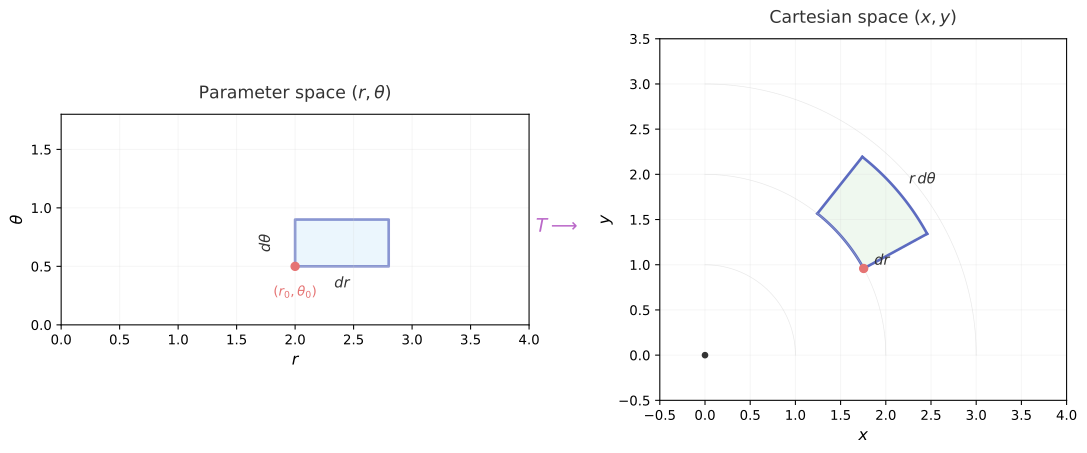
Take a small rectangle in parameter space. What is the area of its image in the -plane?
For polar coordinates, you can see it directly: the image is a thin wedge with sides (radial) and (arc length). Area .
For a general transformation , the image of a small rectangle is approximately a parallelogram spanned by two vectors:
These are the images of the two edges of the rectangle under the linear approximation of . The area of a parallelogram in 2D is the absolute value of the cross product of its sides:
That expression is , where:
Verification for polar:
The change of variables theorem
In words: To integrate over a region in the -plane using new coordinates , you substitute the transformation into , and multiply by the absolute value of the Jacobian determinant — the local area scaling factor. This works as long as the transformation doesn’t collapse any area to zero () and doesn’t map two different parameter points to the same output (injective).
Hypothesis: Let be a map, injective on the interior of , with on .
Thesis:
The hypotheses ensure:
- : the map is locally invertible (Inverse Function Theorem). The parallelogram never collapses — areas scale but don’t vanish.
- Injective: different points map to different points, so area isn’t double-counted.
When : the polar origin
At , the Jacobian determinant vanishes. Geometrically: every value of maps to the same point — the map is not injective, and the “parallelogram” collapses to a point.
In practice this is harmless: the origin is a single point (measure zero) and doesn’t affect the integral. The theorem allows failure of injectivity on a set of measure zero. But it explains why polar coordinates are technically valid only for .
The 3D generalization
The same logic extends: a small box maps to a parallelepiped whose volume is .
Cylindrical : , so .
Spherical where is the polar angle from the -axis:
Geometric reading: a small box in spherical has sides , , and . The last factor is the radius of the azimuthal circle at colatitude .
The wedge product: making the naive substitution work
There is a way to multiply differentials and get the Jacobian automatically — the wedge product , which satisfies and (antisymmetric).
Compute :
Expand — all and terms vanish:
The determinant falls out of the antisymmetry algebra. This is not a coincidence: the determinant is the wedge product. The change of variables formula says the area 2-form transforms by the determinant.
Questions to sit with
-
For a linear map , the Jacobian is constant (). Every rectangle scales by the same factor. What shape is the image of the unit square?
-
In spherical coordinates, vanishes on the -axis ( or ) and at the origin (). What is the geometric failure at each?
-
Why does ordinary multiplication of and not work, but the wedge product does? What algebraic property of kills exactly the terms that would give wrong answers?
See also
- The Gradient in Curvilinear Coordinates — scale factors appear there too
- The Implicit Function Theorem — the condition
- 1-Forms and the Dual Basis — the wedge product formalism