Pinterest’s Foundation Ranking Model (FRM) is a recommendation ranking model trained for high-traffic surfaces such as Home feed and Related Pins. The training-scalability article is not mainly about serving-time retrieval or vector search. It is about making multi-node training work for an embedding-heavy ranking model whose lookup tables made the training step communication-bound.
Read the cluster in this order:
| Question | Note |
|---|---|
| What does the ranker do at serving time? | Recommendation Ranking Models |
| How does an id become a learned vector? | Categorical Feature Embeddings in Recommender Systems |
| Why do embedding tables dominate model size? | Embedding-Heavy Models |
| Why is there a distributed lookup shuffle? | Distributed Training for Embedding-Heavy Recommenders |
| What are all-to-all and all-reduce? | GPU Collective Communication |
| How do the reported speedups work? | Training Scalability for Distributed ML |
This note owns the article narrative: the bottleneck Pinterest found, the sequence of fixes, and what those fixes mean for training and product work.
The Bottleneck
One training batch explains the problem. A GPU worker receives candidate-row examples containing user, Pin, board, query, and action ids. Some embedding rows are local; others live on other GPUs. Before the worker can run the interaction layers, it needs the vectors for those ids.
worker batch:
  row A: user_42, pin_77, board_789
  row B: user_99, pin_12, board_555

lookup ownership:
  local worker has some rows
  remote workers own other rows

forward step:
  send lookup requests to row owners
  receive embedding vectors
  assemble candidate tensors
  run dense/transformer compute
That lookup exchange became the limiter. Pinterest describes FRM as approximately 99% embedding-table weights, with dense transformer layers accounting for the rest. The dense transformer layers were not the measured multi-node bottleneck; the embedding lookup exchange was.
Optimization Path
The article’s optimization sequence removed communication pressure layer by layer. The diagram includes the pre-EFA result, where adding a second 8-GPU node made training much slower than one node.
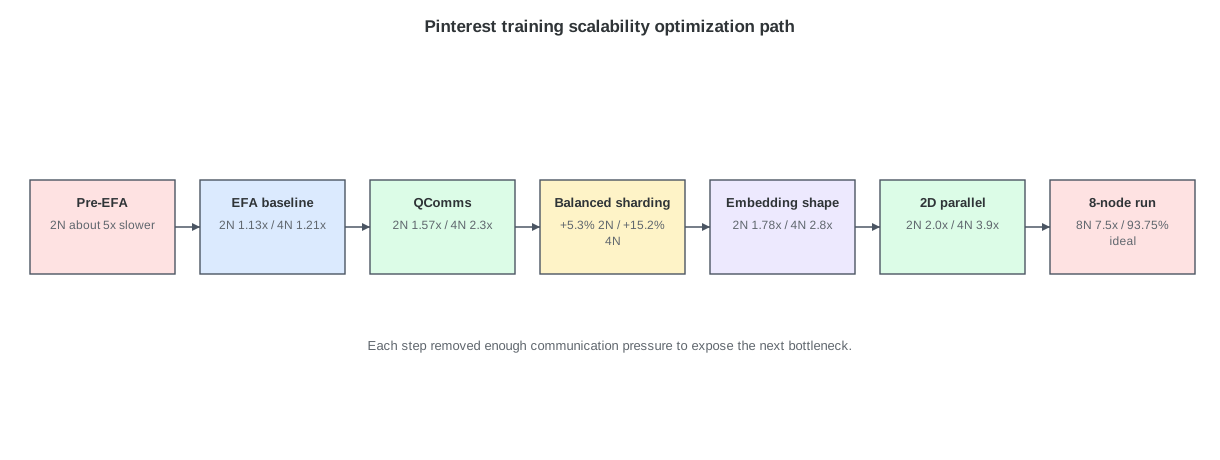
The sequence is easier to read as a set of bottleneck removals:
| Step | What changed | Bottleneck attacked |
|---|---|---|
| EFA | cross-node communication used AWS Elastic Fabric Adapter | network path viability |
| QComms | embedding payloads were compressed from FP32 to FP8 for communication | bytes per value |
| Balanced sharding | hash partition choices were aligned with GPU ownership | slow overloaded row owners |
| Narrower embeddings | embedding dimension was halved while row count doubled | values returned per lookup |
| 2D parallelism | lookup all-to-all was kept local inside replica groups | cross-node all-to-all topology |
The pattern matters more than the names. Pinterest did not find one distributed-training switch that removed every bottleneck. Each change exposed the next remaining limiter.
EFA Made Multi-Node Training Viable
The pre-EFA result showed the failure mode: adding a second node made training slower instead of faster. AWS Elastic Fabric Adapter gave the job a better EC2 network path for HPC and AI/ML communication.
After EFA, multi-node training worked but still scaled poorly: the article reports 1.13x at two nodes and 1.21x at four nodes. That result means the network path was no longer catastrophically bad, but extra nodes still added too much waiting.
QComms Sent Fewer Bytes
FBGEMM QComms reduced communication payload size by sending selected embedding communication tensors in FP8 instead of FP32. The local model arithmetic and stored checkpoint did not have to become FP8 just because the wire payload used FP8.
The byte arithmetic is the core idea:
1,000,000 lookup vectors x 128 values x 4 bytes = 512 MB
1,000,000 lookup vectors x 128 values x 1 byte  = 128 MB
Pinterest reported the largest NCCL send/recv operation shrinking by more than 75%. Scaling improved to 1.57x at two nodes and 2.3x at four nodes. Full training jobs still had to converge equivalently, because faster communication is useless if the model quality changes.
Balanced Sharding Removed Slow Owners
After reducing bytes, Pinterest could see shard imbalance. Some GPUs owned more expensive embedding work than peers, so the slowest owner gated the step.
A hash partition maps an id to a bucket:
partition = hash(pin_id) % number_of_partitions
owner_gpu = placement[partition]
If partitions and GPU ownership do not align cleanly, one GPU can inherit more partitions or hotter partitions than its peers. Aligning hash partitions with GPU count gave the planner a cleaner ownership mapping. The article reports +5.3% at two nodes and +15.2% at four nodes from this step.
Narrower Embeddings Reduced Values Per Lookup
Pinterest then changed embedding table shape by halving embedding dimension and doubling row count. The total stored values can stay constant while the lookup payload changes:
| Shape | Row count | Dimension | Total values | Values returned per lookup |
|---|---|---|---|---|
| Wider table | 100M | 256 | 25.6B | 256 |
| Narrower table | 200M | 128 | 25.6B | 128 |
Both shapes store 25.6 billion values before optimizer bookkeeping. The narrower table returns half as many values per lookup, so all-to-all moves fewer bytes per example. Scaling improved to 1.78x at two nodes and 2.8x at four nodes.
2D Parallelism Kept Lookup Local
Standard global sharding spreads embedding rows across all GPUs in the cluster. That makes cross-node lookup all-to-all likely as the cluster grows.
2D parallelism groups GPUs, typically by node. Each group holds one complete model replica sharded across local GPUs. Lookup all-to-all stays inside the group, and cross-node communication synchronizes replicas. Pinterest then optimized the rank topology around all-to-all locality. The article reports all-to-all latency falling from 78 ms to 13 ms.
Scaling reached 2.0x at two nodes and 3.9x at four nodes, or 97.5% of ideal for four nodes. The later eight-node run reached 7.5x, or 93.75% of ideal, with 490k examples per second.
Framework Work Made The Loop Operable
The article also describes work that does not fit neatly into one communication formula:
| Area | Why it mattered |
|---|---|
| Distributed Checkpoint | sharded checkpoints could load across different world sizes for pre-training and fine-tuning |
| PyTorch and TorchRec upgrades | production training exposed Triton mismatches, NCCL build conflicts, and profiler crashes |
torch.compile | kernel fusion improved single-node throughput separately from multi-node scalability |
Multi-node training only helps if jobs can checkpoint, resume, profile, and upgrade without turning every experiment into infrastructure recovery.
Product Meaning
The infrastructure work changed what could be trained. It did not automatically change the serving system. A larger multi-node teacher model can produce better training targets for a smaller serving student model through teacher-student distillation. The student model still needs offline metrics, serving-cost checks, online experiment results, and rollout controls.
The product chain is:
| Infrastructure result | Possible downstream effect |
|---|---|
| near-linear multi-node training | train larger models or train the same model faster |
| faster training runs | shorter experiment cycles |
| larger teacher models | stronger distillation targets |
| validated student model | candidate for serving after evaluation |
| better deployed ranker | possible engagement gains on recommendation surfaces |