epoll is Linux’s readiness-notification API: the application registers file descriptors, then asks the kernel which of those descriptors are ready for an operation such as read or write.
Prerequisites
Read IO Selectors first. eventfd explains how another thread can wake an
epollloop. Threads helps with the thread-per-connection baseline, and OS Page Cache helps with the disk-I/O caveats.
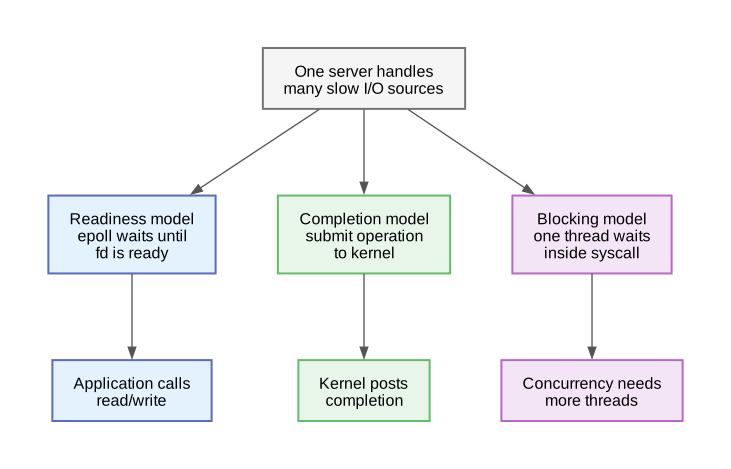
The diagram separates readiness from completion. epoll tells the application “this descriptor should not block now”; it does not perform the read or write for the application.
The Problem
A blocking file descriptor call waits inside the kernel until the operation can make progress. A thread can block in read waiting for bytes from a pipe, accept waiting for a new TCP connection, or write waiting for buffer space.
One thread per descriptor is easy to understand because each thread follows one blocking operation at a time. The cost is that concurrency is paid for with more kernel-scheduled threads. A selector loop pays with explicit state instead: the loop waits for readiness events, then advances whichever descriptor can make progress.
The Mechanism
An epoll instance is an in-kernel object with two conceptual lists:
| Structure | Meaning |
|---|---|
| Interest list | File descriptors the process asked the kernel to watch. |
| Ready list | Watched descriptors that the kernel currently considers ready for one or more requested operations. |
The usual lifecycle is:
epoll_create1creates anepollinstance and returns anepollfile descriptor.epoll_ctladds, modifies, or removes watched descriptors.epoll_waitblocks until the ready list has events, then copies a batch of events back to user space.- The application calls
read,write,accept, or another operation on each ready descriptor.
epoll_wait returns readiness, not bytes. After a socket becomes readable, the application still has to call read. After a socket becomes writable, the application still has to call write.
Level-Triggered And Edge-Triggered
epoll has two common delivery modes:
| Mode | Meaning | Practical rule |
|---|---|---|
| Level-triggered | Keep reporting the descriptor while the readiness condition remains true. | Simpler; repeated notifications are expected until the condition is cleared. |
| Edge-triggered | Report when the descriptor changes into a ready state. | Use non-blocking descriptors and drain reads/writes until EAGAIN. |
EAGAIN means “try again later”: for a non-blocking descriptor, the operation would have blocked, so the event loop should stop working on that descriptor and return to epoll_wait.
Edge-triggered mode is easy to misuse. If a socket receives 2 KiB, the event loop reads only 1 KiB, and no new data arrives, there may be no second edge to wake the loop. The unread 1 KiB remains in the socket buffer, but the application can sleep because it failed to drain the descriptor.
What epoll Can Watch Well
epoll works naturally with descriptors whose readiness changes over time, such as sockets, pipes, timers, and event file descriptors. Linux epoll_ctl rejects regular disk files with EPERM, so a program cannot register an ordinary file and wait for “file read completed” events.
Disk I/O can still block. Opening or reading a file can wait on metadata, page-cache misses, storage queue slots, or filesystem work. epoll is not the right API for being notified when a regular file read has completed.
The boundary looks like this:
| Operation | epoll helps? | Why |
|---|---|---|
| Accept a new TCP connection | Yes | The listening socket becomes readable when a connection can be accepted. |
| Read bytes from a socket or pipe | Yes | The descriptor becomes readable when bytes are queued. |
| Write bytes to a socket or pipe | Yes | The descriptor becomes writable when buffer space exists. |
| Wait for a timer | Yes | timerfd exposes timer expiration as descriptor readiness. |
| Receive a thread notification | Yes | eventfd exposes application notifications as descriptor readiness. |
| Read a regular disk file | No | Regular files are not supported by epoll_ctl; file reads are not reported as completion events. |
Programs that must avoid blocking on disk add another mechanism: a disk-I/O thread pool, asynchronous file APIs, sendfile where it fits, or io_uring.
State Lives In The Application
The blocking function style stores progress on the call stack. An event-driven program stores progress in application-owned objects because work resumes over multiple readiness events.
For a descriptor that receives bytes and later writes bytes, that object usually needs:
| Field | Why it exists |
|---|---|
| File descriptor | The descriptor to read from or write to. |
| Input buffer and offset | Input may arrive over multiple reads. |
| Output buffer, length, and offset | write may accept only part of the pending output. |
| State enum | The event loop needs to know whether the descriptor is reading, writing, waiting for external work, or closing. |
Partial writes happen routinely. A successful write(fd, buf, 16384) may return 4096, meaning only 4 KiB reached the socket buffer. The event loop records the remaining 12 KiB and waits for another writable event.
The HTTP file-server state machine belongs in Multi-Threaded epoll HTTP File Server Architecture. The epoll note only covers the readiness mechanism.
When To Use
Use epoll when the workload is mostly descriptor readiness: many network sockets, pipes, timers, or eventfd-style coordination objects. It is a good fit for a single-threaded or per-core event loop where the application owns the state machine.
Avoid treating epoll as a universal asynchronous I/O interface. It multiplexes readiness for suitable file descriptors; it does not turn arbitrary blocking work into completion events.
See also
Sources
- Linux man-pages:
epoll(7)andepoll_ctl(2).