The Gradient in Curvilinear Coordinates
Prerequisites
- Directional Derivatives and the Gradient — the Cartesian gradient,
- Change of Variables and the Jacobian — coordinate transformations, scale factors
- Derivatives, Differentials, and the Chain Rule — total differentials
The problem: a gradient that “disagrees” with itself
Compute the gradient of where .
Cartesian computation (straightforward):
Naive polar attempt (wrong): In polar coordinates , so and . If you blindly write “the vector of partial derivatives” you get . This seems to disagree with the Cartesian answer.
Correct polar formula:
Converting back via :
The answers agree. The “disagreement” came from misapplying the Cartesian formula in a non-Cartesian system.
The true definition of the gradient
The gradient is not “the vector of partial derivatives.” That formula happens to work in Cartesian coordinates as a coincidence of their special geometry.
Coordinate-free definition
The gradient is the unique vector field satisfying: for every spatial displacement .
Equivalent geometric characterizations:
- Best linear approximation:
- Direction of steepest ascent: points in the direction of maximum rate of increase of ; its magnitude is that rate, measured per unit distance in space
- Normal to level sets: is perpendicular to the level curves/surfaces of
All of these are geometric statements — they don’t mention coordinates at all.
Why Cartesian coordinates hide the issue
In Cartesian coordinates, three special properties hold simultaneously:
- Basis vectors are unit length
- They are mutually orthogonal
- A coordinate increment equals the corresponding spatial displacement ( in coordinate = in distance)
Property (3) is the one that fails in curvilinear coordinates. The gradient component should be “rate of change per unit distance,” but a partial derivative gives “rate of change per unit coordinate.” When these differ, you need a correction factor.
Where the comes from
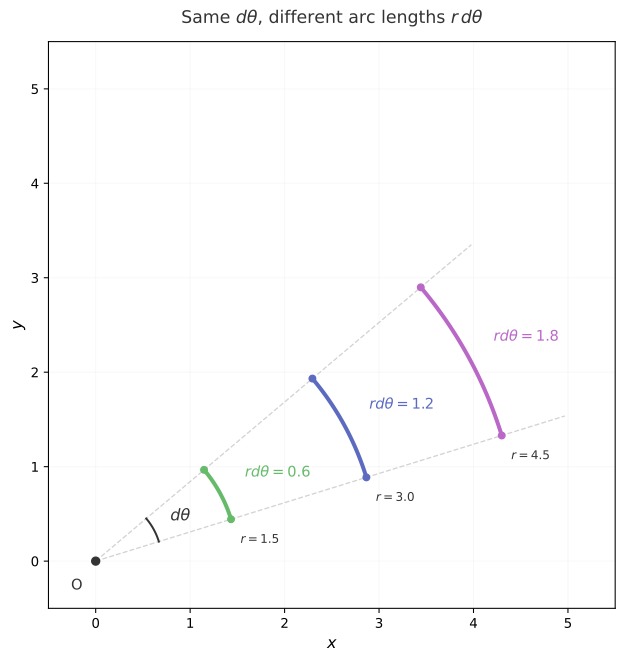
In polar coordinates, a displacement of at radius corresponds to an arc length of . The spatial displacement vector is:
The two terms in are physical lengths:
- moving radially by coordinate amount moves a distance
- rotating by coordinate amount moves a distance along the circle
That is the scale factor. It converts an angular coordinate change, measured in radians, into an actual distance traveled in space.
The total differential of is a scalar change in the function value:
This expression still uses coordinate increments. The term says: “change in per radian, times the number of radians moved.” It is not yet a rate per unit distance around the circle.
Now set . Since the gradient must satisfy for every small displacement,
Matching term by term with the chain rule expression:
The -component has to satisfy:
so . The converts “change per radian” into “change per unit distance along the arc.”
Physical intuition
At radius , walking 1 radian around the origin moves you 100 meters along the arc. A function changing by 1 unit per radian is actually changing by only units per meter. The “real” spatial rate of change is , not . Dividing by performs this conversion.
The general pattern: scale factors
Notation
= scale factor for coordinate , defined as the spatial distance per unit coordinate increment:
For any orthogonal coordinate system with scale factors :
The spatial displacement vector is .
Scale factors for common coordinate systems
| Coordinate system | Coordinates | Scale factors |
|---|---|---|
| Cartesian | ||
| Polar (2D) | ||
| Cylindrical | ||
| Spherical |
Cartesian is “special” only in that all scale factors equal 1, collapsing the formula to the naive “vector of partial derivatives.”
Spherical example
For :
The factor for reflects that the azimuthal circle at colatitude has radius , not .
Conceptual reframing
| Misleading statement | Correct statement |
|---|---|
| ”The gradient is the vector of partial derivatives" | "The gradient is a geometric vector defined by . Its component formula depends on the coordinate system." |
| "Different coordinates give different gradients" | "Different coordinates give different formulas for the same gradient. The gradient itself is coordinate-independent." |
| "Partial derivatives = gradient components" | "Partial derivatives are rates per unit coordinate. Gradient components are rates per unit distance. They’re equal only when scale factors are 1.” |
Connection to broader mathematics
This insight is the entry point to several deeper subjects:
- Differential geometry: geometric objects (vectors, tensors, forms) exist independently of coordinates; coordinate formulas transform under coordinate changes
- The metric tensor: generalizes scale factors to non-orthogonal and curved coordinates. In orthogonal coordinates, the metric is diagonal:
- Divergence, curl, Laplacian: also acquire scale factors in curvilinear coordinates. The Laplacian in spherical coordinates is famously unwieldy for this reason
- Differential forms: the cleanest framing is ” is a 1-form, is its metric-dual vector.” The metric encodes the scale factors
Questions to sit with
-
The gradient of (the polar angle function) is . Its magnitude is — the gradient gets weaker further from the origin. Why does this make geometric sense? (Hint: think about how tightly packed the level curves are at different radii.)
-
In spherical coordinates, the -component of the gradient has scale factor , not . Draw the picture: at the north pole (), what happens to the azimuthal circle? What does mean geometrically?
-
If you define “the gradient” as “the vector of partial derivatives” in polar coordinates, does the resulting vector still point in the direction of steepest ascent? Is it still perpendicular to level curves? (Test with .)
See also
- Directional Derivatives and the Gradient — the Cartesian case and geometric consequences
- Change of Variables and the Jacobian — scale factors appear there too (in the volume element)
- 1-Forms and the Dual Basis — as a 1-form, the gradient as its metric dual