A recommendation ranking model is the scoring model in a recommender serving path. In the Machine Learning Model Shapes map, it is a ranker: for one user request, it receives candidate items that earlier retrieval systems found, builds one feature row per (request, candidate) pair, and returns prediction scores that a feed, search, or related-item surface can use to order a response.
The serving vocabulary is: request, candidate set, candidate row, ranker output, response, and logged opportunity. Embedding-table training and GPU tensor exchange start after this serving path is clear.
One Request Path
This diagram follows one Home feed request from client input to ranked response. Retrieval produces the candidate set. Ranking spends more features and model compute on that bounded set.
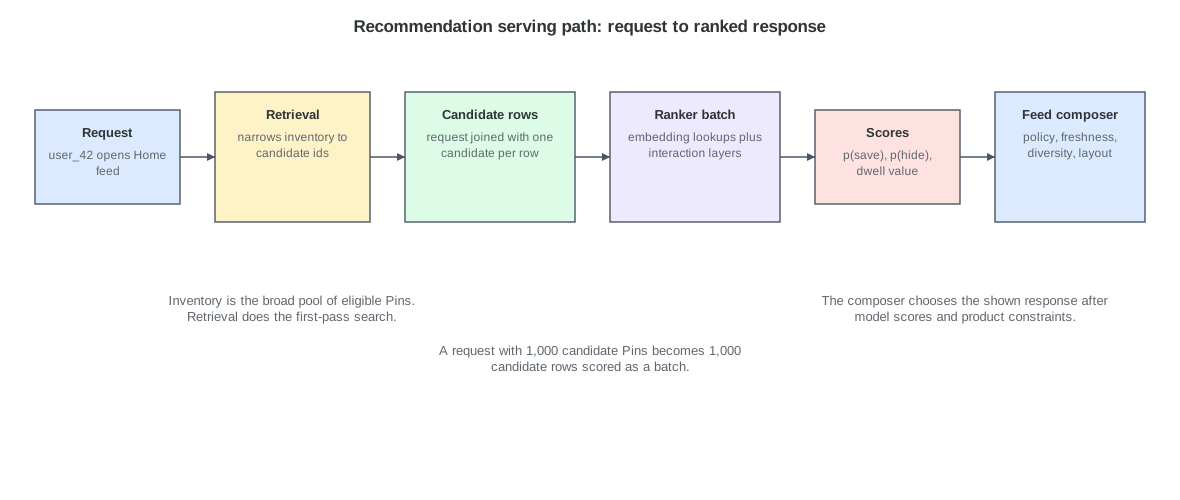
The serving path has these objects:
| Object | What it contains | Produced by |
|---|---|---|
| Request | user id, surface, device, country, session, privacy state, and current context | client and serving front end |
| Candidate set | candidate item ids and lightweight records | retrieval systems |
| Candidate row | one request joined with one candidate’s features | feature assembly layer |
| Ranker output | one or more scores for one candidate row | ranking model |
| Response | ordered items after policy, freshness, diversity, and layout constraints | feed composer |
If retrieval returns 1,000 candidate Pins, the ranker usually scores 1,000 candidate rows as one batch. The model output is still per candidate:
request = {user_id: 42, surface: home, device: mobile}
candidates = [pin_77, pin_91, pin_123]

ranker outputs:
  pin_77  -> p(save)=0.18, p(hide)=0.02
  pin_91  -> p(save)=0.07, p(hide)=0.01
  pin_123 -> p(save)=0.11, p(hide)=0.04
The feed composer then combines model scores with product constraints. It may diversify creators, enforce policy eligibility, account for freshness, or choose a layout. The ranker scores candidates; it does not by itself decide the entire response.
Candidate Row Shape
One candidate row contains facts about the request, the candidate, and the current context. Some facts are ids that later become embedding lookups; others are measured or precomputed values.
| Feature family | Example values | How the ranker sees it |
|---|---|---|
| Request facts | user_42, Home feed, mobile, country | ids, flags, or normalized values |
| Candidate facts | pin_77, creator id, topic ids, age | ids plus numeric features |
| Context facts | board_789, query text, recent saves | ids, sequences, or text-derived features |
| Upstream signals | retrieval source, quality score, policy flags | numeric values or categorical ids |
Categorical Feature Embeddings in Recommender Systems explains one id-to-vector lookup. Multiple Embedding Tables in Recommender Rankers explains how a full candidate row fans out across several table families before the ranker has an assembled input tensor.
Retrieval Boundary
Retrieval is the upstream candidate-generation stage. Its job is recall under latency: find a bounded set of plausible items from a much larger inventory. Retrieval may use graph expansion, inverted indexes, approximate nearest-neighbor vector search, freshness pools, followed-entity expansion, or other low-latency sources.
Ranking is the downstream scoring stage. It receives candidate ids and candidate-side features from retrieval, joins them with request context, and computes prediction scores. The Pinterest scalability article concerns training a ranking model, so serving-time vector search belongs to retrieval unless a system deliberately reuses ranker representations inside a retrieval index.
Logged Opportunities
A logged opportunity is the serving record that later becomes a training example. The log needs enough context to reconstruct what the ranker scored and what happened afterward.
served candidate row:
  request_id: req_abc
  user_id: user_42
  candidate_id: pin_77
  context_board_id: board_789
  retrieval_source: related_board
  model_version: frm_2026_06_28
  position: 4

later labels:
  shown: true
  clicked: false
  saved: true
  hidden: false
Shown items can receive impression, click, save, hide, dwell, skip, or conversion labels. Retrieved-but-not-shown candidates can be used as sampled negatives only when the training pipeline knows how they were sampled. The logging policy defines the training data; it is not a cosmetic detail.
Where Training Begins
The serving path stops at candidate rows, scores, and logs. The training path follows the same row into lookup tables, model size, and distributed training:
| Next question | Note |
|---|---|
How does board_id=789 become a vector? | Categorical Feature Embeddings in Recommender Systems |
| How does one row gather from several tables? | Multiple Embedding Tables in Recommender Rankers |
| Why can lookup tables dominate model size? | Embedding-Heavy Models |
| Why do GPUs need to exchange rows during training? | Distributed Training for Embedding-Heavy Recommenders |
| What does near-linear training scalability mean? | Training Scalability for Distributed ML |
Sources
- Pinterest Engineering - Achieving Near-Linear Training Scalability for Pinterest’s Foundation Models
- PyTorch - Linear
- PyTorch - MultiheadAttention